Showing posts with label 2008. Show all posts

Thursday, 5 November 2020

Lemon Tree
Dir: Eran Riklis
2008
*****
Director Eran Riklis had covered personal relationships between Arabs and Middle Eastern Jews in his previous films The Syrian Bride and Cup Final, achieving widespread success in Israel as well as with international audiences. It’s safe to say expectations for his next film were high but when dealing with a story like Lemon Tree, he was always going to upset someone. I think it is an extraordinary film but even though Riklis says its not about the Israeli-Palestinian conflict, it clearly is and he shouldn’t shy away from the fact. That said, the end message is universal. The story begins when the Israeli Defense Minister Israel Navon (Doron Tavory) moves to a house on the border between Israel and the West Bank, with the building sitting on the Israeli side just next to the dividing line. The Israeli Secret Service views the neighboring lemon grove of Salma Zidane (Hiam Abbass), a Palestinian widow whose family has cared for the area for generations, as a threat to the minister and his wife. The security forces soon set up a guard post and a fence around the grove. They then obtain an order to uproot the lemon trees. Salma feels isolated given that her son has moved to Washington, D.C. and her daughters are now married. The local village elder Abu Kamal (Makram Khoury) advises her to give in, but Salma decides to work with the young lawyer Ziad Daud (Ali Suliman). They take their case all the way to the Supreme Court. All the while Mira Navon (Rona Lipaz-Michael), the minister's wife, sympathizes with Salma as she watches her from over the fence. The court case receives notable media attention, and Mira gives a news interview that her husband regrets. Mira believes that the Israeli military overreacted, and she also shares Salma's sense of personal loneliness. Although they never speak, a complex human bond develops between the two women. As the Palestinian cause is dismissed, Mira decides to leave her husband and a stark concrete wall is built between Salma's land and the Defense Minister's house. A final camera shot reveals the lemon trees have all been pruned. It’s about as devastating a final moment of a film can be. Riklis has said that he designed the film to be essentially apolitical, focusing on character development rather than exploring the issues of the Israeli–Palestinian conflict. He has said that he created a 'fairy tale quality' to the film in which the audience can sympathize with all of the people featured in it. He stated that "I wanted to populate this film with a lot of faces and give each character their own moment of grace, even when, on the surface, it's one of the 'bad guys,' so to speak.. ... This film does address the ugly side of occupation perhaps, yet no blood is spilled.” A fictional representation of the Israeli West Bank barrier punctuates the film throughout. While he has a point, the uprooting of the lemon trees feels almost as bad as a death. Your opinion of the film really depends upon your views but I think the viewer should reflect upon the fact that Riklis is Israeli himself. Those who criticised the film the loudest upon its release also claimed the film was too "fem-centric", as well as anti-Israeli and pro-Palestinian. I think that speaks volumes. The truth is, the plot was based on a real life incident. Israeli Defense Minister Shaul Mofaz moved to the border within Israel and the occupied territories and security forces began cutting down the lemon trees beside his house, arguing that it could be used by terrorists as a hiding place. The Palestinian family who owned the trees sued the minister and took the case all the way to the Israeli Supreme Court. They lost, and their trees had to be cut down. Riklis watched a news report about the case online before developing the story further in a fictional setting. It really does make all criticism and accusations of it being anti-Israeli quite absurd, it is essentially a true story. Riklis forges into areas other Israeli filmmakers won't venture and I’m glad he does. Salma and Mira are fictional characters but there are thousands of Salmas and Miras in the middle east, this film is for them. Unsurprisingly, the film did well in Palestine but not so well in Israel. The conflict will go on for a long time, hopefully the Salmas and the Miras will one day be able to communicate and live together, and hopefully there will be some lemons left for them both to enjoy. One day this will be a film people watch in history lessons and they will struggle to understand how the world can be this way, that day can’t come soon enough. Thankfully we have artists and film makers like Riklis who are bold enough to communicate with both sides at risk to himself and his career.

Thursday, 17 October 2019

Hellboy II: The Golden Army
Dir: Guillermo del Toro
2008
****
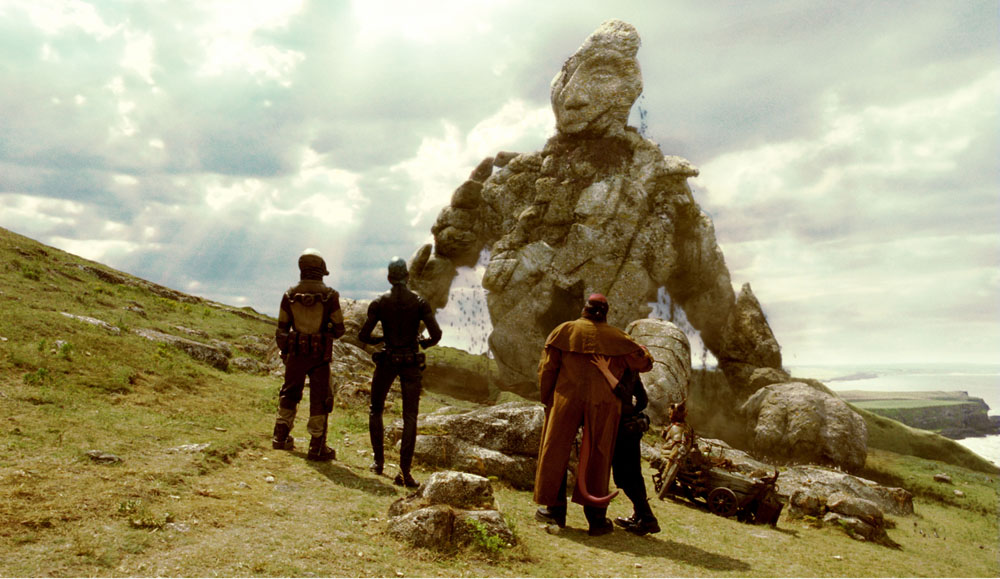
2004’s Hellboy is, in many respects, the perfect comic adaptation. It worked brilliantly thanks to writer/director Guillermo del Toro’s talent, passion and understanding of the source material. That and the fact he worked closely with the character’s creator Mike Mignola, and he found the only man who could have ever have brought said character to life, meant that the team had all the ingredients they needed for the recipe of success. Why there were issues getting a second film off the ground is a frustrating puzzle. A sequel to 2004’s Hellboy was announced a month after the film’s release, with del Toro returning to direct and Ron Perlman reprising his lead role as the title character. The critics loved it, the fans loved it and most importantly (to the studio) it made money. Del Toro wanted to create a film trilogy with the first sequel anticipated for release in 2006. Revolution Studios planned to produce the film and distribute it through a deal with Columbia Pictures, but by 2006, their distribution deal wasn't renewed and Revolution began refocusing on exploiting their film library. In August 2006, Universal Pictures acquired the project with the intent to finance and distribute the sequel, which was newly scheduled to be released in summer of 2008. Quite why Revolution Studios struggled with this is a mystery. With the passing of time, the original idea became something entirely new. del Toro explored several concepts for the sequel, initially planning to recreate the classic versions of Frankenstein, Dracula and The Wolf Man. He and Hellboy creator Mike Mignola also spent a few days adapting the Almost Colossus story, featuring Roger the Homunculus. They then found it easier to create an original story based on folklore, because del Toro was planning Pan's Labyrinth, and Mignola's comics were becoming increasingly based on mythology. Later, del Toro pitched a premise that involved four Titans from the four corners of Earth - Wind, Water, Fire, and Earth - before he replaced the Titans with a Golden Army. Mignola described the theme of the sequel, "The focus is more on the folklore and fairy tale aspect of Hellboy. It's not Nazis, machines and mad scientists but the old gods and characters who have been kind of shoved out of our world.” Del Toro released Pan's Labyrinth in 2006, and the film earned multiple Academy Awards, providing the director enough clout to begin production on the film with almost complete control. It was a frustrating wait and it felt like the film would never come but as it happened the delay was a good thing as far as the story went. I liked the new direction of story, it worked and felt true to what del Toro was getting known for and the direction a lot of Mignola's work was going. I also loved the way they got John Hurt to return. During Christmas 1955, a young Hellboy is told a bedtime story by his adoptive father, Trevor Bruttenholm (Hurt), of an ancient war between human and magical creatures. After the magical creatures are driven back by the humans, the goblin blacksmiths extend an offer to Balor, king of the elves, to build him an indestructible mechanical army. Encouraged by his son Prince Nuada, Balor accepts; the Golden Army subsequently devastates humanity. Regretting his actions, Balor forms a truce with the humans, that they will keep to the cities and the magical creatures to the forests. The crown to command the Golden Army, which can only be worn by one of royal blood, is split into three pieces. Nuada, disagreeing with the truce, leaves in exile. In the present, Nuada (Luke Goss of Bros fame) returns and begins gathering the pieces of the crown. He collects the first piece from an auction, unleashing tooth fairies, voracious flying creatures that eat the crowd alive, and kills his father for the second piece. His twin sister, Princess Nuala, escapes with the final piece. Meanwhile, at the B.P.R.D., Hellboy is having issues with his girlfriend Liz, and dislikes that their organization must operate in secrecy. Investigating the auction slaughter, Hellboy allows himself to be revealed to the world. In the commotion, Abe Sapien discovers Liz is pregnant; she swears him to secrecy. Furious at Hellboy's actions, the Bureau's superiors send the ectoplasmic medium Johann Krauss to rein him in. With Krauss in charge, the team tracks the tooth fairies to a secret market under New York’s Brooklyn Bridge. Abe finds Nuala, who has obtained a map leading to the Golden Army, and falls in love with her. Hellboy fights and kills Nuada's accomplice Wink and an elemental forest god that Nuada summons against him. During the fight Nuada questions why he fights for the humans when they have driven the magical creatures into hiding, of which he too is one. Nuala is taken under the B.P.R.D.'s protection. Nuada tracks his sister to the B.P.R.D. headquarters using their magical bond, which causes them to share wounds and read each other's thoughts. Nuala hides the final crown piece before Nuada finds her and he battles Hellboy. Nuada critically wounds Hellboy with his spear and abducts Nuala, promising her return in exchange for the crown piece. Unable to remove the spear shard in his wound, Liz and Abe decide to take Hellboy to the Golden Army's location in the Giants Causeway in Northern Ireland. Krauss comes along, as he sympathizes with Liz, revealing that he too lost his wife in the accident that caused the loss of his own body. They encounter the Bethmoora goblin master blacksmith who brings them before the Angel of Death to retrieve the spear shard. Though warned Hellboy will doom humanity if he lives and that she will suffer the most from it, Liz pleads for Hellboy's life. The Angel removes the shard from Hellboy's chest and tells Liz to give him a reason to live. She reveals to Hellboy that he will be a father, and he recovers. The goblin leads the team to the resting place of the Golden Army, where Nuada awaits them. Abe gives him the last piece of the crown, and Nuada awakens the Golden Army and commands them to kill the team. Hellboy challenges Nuada for the right to command the army; as Hellboy is a member of Hell's royal family, Nuada must accept the challenge. Hellboy defeats Nuada and spares his life, but Nuada tries stabbing him. Nuala commits suicide to stop her brother; the dying Nuada tells Hellboy he will have to choose whether humanity or magical beings must die. Abe psychically shares his feelings with Nuala before she dies. Liz melts the crown apart, deactivating the Golden Army. Hellboy, Liz, Abe, and Johann resign from the B.P.R.D., and Hellboy contemplates his future life with Liz and their baby. Liz corrects "babies", revealing that she is pregnant with twins. It is a crime against cinema that we never saw a third installment, especially featuring baby Hellboys/Hellgirls. The special effects were amazing, so much so that even the fantasy elements were believable. All the key players were back and Doug Jones was allowed to use his own voice. The sequel was far more fast and loose than the first, which suited the established humour rather well and let the characters shine over the story. While I’m not alone in feeling completely robbed of a third film, the story is left in a nice place. I will try to appreciate Hellboy II in all its greatness without wondering what could have come next, as perhaps we all should.

Tuesday, 25 June 2019

The Midnight Meat Train
Dir: Ryuhei Kitamura
2008
**
I wasn’t sure what convinced me to watch The Midnight Meat Train. While I will give any film a try, it wasn’t something that I immediately thought I’d enjoy but there was something about it that intrigued me. Of course fifteen minutes in I realised the connection – it was based on one of Cliver barker’s Books of Blood stories, a collection of horror shorts I adored reading in the late 1980s and had almost forgotten about. It all came flooding back and I remember at the time (I believe it was 1989, on a Spanish beach on the Costa Brava) that a film adaptation of the stories would be amazing. Twenty years later (actually, thirty years later, as it has taken me ten years to get round to watching it), I feel somewhat cheated. I remember liking Pig Blood Blues and In the Hills, the Cities far more than The Midnight Meat Train but it still had one hell of an ending. It was a moment in my adolescence where I discovered great horror and horror story telling. Why on earth the makers of Ryuhei Kitamura’s adaptation thought that casting Vinnie Jones as Mahogany was a good move is anyone’s guess, surely that was a late 90s mistake film makers made? Gone in 60 Seconds should have been the last of Jones’ Hollywood affair and if that wasn’t enough, then X-Men: The Last Stand should have underlined as much. X-Men: The Last Stand was released two years before The Midnight Meat Train, so maybe contracts were already signed, but any credibility the film had of being even the slightest bit scary, was pissed up the wall when Jones was cast as the story’s villain. The role didn’t need a hard man, it needed a terrifying one. The story follows a man called Leon (a relatively fresh-faced Bradley Cooper), a photographer who wants to capture unique, gritty shots of the city and the people who live in it. He is crushed when, instead of giving him his big break, gallery owner Susan (Brooke Shields) instead criticizes him for not taking enough risks. Emboldened, he heads into the city's subway system at night, where he takes pictures of an impending sexual assault before eventually saving the woman. The next day, he discovers that the woman he saved has gone missing. Intrigued by the mystery, he investigates reports of similar disappearances. His investigation leads him to a butcher named Mahogany (Vinnie Jones), who he suspects has been killing subway passengers for the past three years. Leon presents his photos to the police, but Detective Hadley (Barbara Eve Harris) disbelieves him and, instead, casts suspicion on his motives. Leon's involvement quickly turns into a dark obsession, upsetting his waitress girlfriend Maya (Leslie Bibb), who is as disbelieving of his story as the police. After stalking Mahogany and barely escaping, Leon follows Mahogany onto the last subway train of the night, only to witness a bloodbath. The butcher kills several passengers and hangs their bodies on meat hooks. After a brief scuffle with Mahogany, Leon passes out on the train's floor. He awakes the next morning in a slaughterhouse with strange markings carved into his chest. A concerned Maya and her friend Jurgis (Roger Bart) examine Leon's photos of Mahogany, leading them to the killer's apartment. After breaking into the butcher's home, Jurgis is captured, though Maya escapes with timetables that record over 100 years of murders on the subway. Maya goes to the police but finds Hadley as skeptical of her story as Leon's. When Hadley presses Maya to return the timetables, Maya demands answers. At gunpoint, Hadley directs Maya to take the midnight train to find Jurgis. Leon, unaware of Maya's involvement, heads to a hidden subway entrance in the slaughterhouse, arming himself with several slaughterhouse knives and wearing a butcher's apron. Leon boards the train as Mahogany has completed his nightly massacre and has cornered Maya. Leon attacks the murderer with a knife, and the two fight in between the swinging human flesh. Human body parts are ripped, thrown, and used as weapons. Jurgis, hung from a meat hook, dies when he is gutted. Finally, Leon throws Mahogany out of the train. The train reaches its final stop, a cavernous abandoned station filled with skulls and decomposing bodies. The conductor steps into the car, advising Leon and Maya to "please step away from the meat." The true purpose of the abandoned station is revealed, as reptilian creatures enter the car and consume the bodies of the murdered passengers. Leon and Maya flee into the cavern. Mahogany, battered and bleeding, returns and fights to the death with Leon. After Leon stabs a broken femur through Mahogany's throat, Mahogany grins in his dying throes, saying only, "Welcome" The conductor appears and tells Leon the creatures have lived beneath the city since long before the subway was constructed, and the butcher's job is to feed them each night to keep them from attacking subway riders during the day. He picks up Leon, and with the same supernatural strength as the deceased butcher, rips out Leon's tongue, throwing him to the ground and eating it. The conductor brings Leon's attention to Maya, who has been knocked unconscious and is lying on a pile of bones. The conductor forces Leon to watch as he cuts Maya's chest open to remove her heart. When he is done, he tells Leon that, having killed the butcher, Leon must take his place. Finally, Detective Hadley hands the train schedule to the new butcher, who wears a ring with the symbol of the group that feeds the creatures. The killer walks onto the midnight train and turns his head to reveal himself as Leon. It is far scarier and clever-sounding in the book than it is in the film. Vinnie Jones is ridiculously miscast, Bradley Cooper and Leslie Bibb are both pretty good but it was only Ted Raimi’s small role that actually excited me. I do wonder what Patrick Tatopoulos’ version would have looked like had he not left the project, I would have chosen Ryuhei Kitamura if I had the choice of the two but this is by far his weakest film. I feel the horror and mystery were overshadowed by the splatter – which was far too prevalent. Sure, this was a story from the Book of Blood but it was always the suspense and thrill that made it a page turner, not the graphic description of each killing. Clive Barker is a master of horror with a huge fan following, so I find it strange how no one seems to be able to adapt his work appropriately, when I would bet there were hundreds of good directors who would jump at the chance – the author himself being one of them.

Friday, 26 April 2019

Tokyo!
Dir: Michel Gondry, Leos Carax, Bong Joon-ho
2008
****
If I was asked to pick any three directors to join together and form an anthology film (in 2008), then I reckon Leos CaraxBong Joon-ho and Michel Gondry would have been high up on the list. Interesting how none of them are actually Japanese, but then I think the idea was to gather three directors who weren’t from Japan, to see the city through their eyes, rather than from the eyes of someone who lives there. That sort of thing doesn’t always work but here it works exceptionally. That said, I wouldn’t say that the short films are about Tokyo as such, rather they are just set there. Michel Gondry begins the film with his short titled ‘Interior design’. It follows young couple Hiroko (Ayako Fujitani) and Akira (Ryō Kase) who have come to Tokyo from the provinces and are staying with a friend Akemi (Ayumi Ito) in her tiny one-room apartment until they can find a place of their own. They have no money and no work but they have a solid and mutually supportive relationship that will seemingly carry each other through any challenge. Akira is an aspiring filmmaker whose debut feature will soon screen in the city and will hopefully lead to a more solid career; in the interim, he lands work wrapping gifts at a local department store. Unfortunately Akemi's demanding boyfriend grows weary of Akemi's house guests leading Hiroko to hit the streets of Tokyo in search of another suitable apartment. Hiroko only managed to find a series of rat-infested hovels that neither she nor Akira can afford on their limited salaries. After Akira's film screens to dubious acclaim, one spectator informs Hiroko of the inherent struggles in relationships between creative types: often, one half of the couple would feel invisible, useless, or unappreciated. Hiroko relates to these feelings wholeheartedly in the wake of her numerous trials and tribulations in the unfamiliar city of Tokyo, and starts to question her role in the relationship. Hiroko wakes up one morning and sees a small hole where light is going through her. When she goes to the bathroom and unbuttons her shirt, she's shocked to see a hand sized hole in her chest with a wooden pole down the middle. As she walks down the street, the hole gets bigger and stumbling as both her feet turn to wooden poles. Eventually Hiroko is turned into a chair, only her jacket is left hanging on the back. People walking past are unaware of the chair's presence until a man picks it up and takes it home. There, she feels ignored as usual but also useful and needed, so she decides to stay. Our protagonist is happy and yet we are sad for her. It’s quite a melancholy tale and visuals are unmistakably the work of Gondry. The second story is by Léos Carax and your enjoyment of it will depend on whether you think Carax is a genius or a nut. The film is called Merde (French for shit) and the main character of the story is an unkempt, gibberish-spewing subterranean creature of the Tokyo sewers called Mr Shit. Denis Lavant plays the titular character who rises from the underground lair where he dwells to attack unsuspecting locals in increasingly brazen and terrifying ways. He steals cash and cigarettes from passersby, frightens old women and salaciously licks schoolgirls, resulting in a televised media frenzy that creates mounting hysteria among the Tokyo populace. After discovering an arsenal of hand grenades in his underground lair, Merde slips into full-on assault mode, hurling the munitions at random citizens and creating an atmosphere of urban terror, which the media promptly laps up and reflects back to its equally voracious television audience. This is Carax’s version of Godzilla. Enter pompous French magistrate Maître Voland (Jean-François Balmer), a dead ringer for the sewer creature's gnarled and twisted demeanor, who arrives in Tokyo to represent Merde's inevitable televised trial, claiming to be one of only three in the world able to speak his client's unintelligible language. The media circus mounts as lawyer defends client in a surreal court of law hungry for a satisfying resolution. Merde is tried, convicted and sentenced to death until justice takes an unexpected turn in his final moments. The final story is called Shaking Tokyo by Bong Joon-hoTeruyuki Kagawa stars as a Tokyo shut-in, or hikikomori as they are known, who has not left his apartment in a decade. His only link to the outside world is through his telephone, which he uses to command every necessity from a series of random and anonymous delivery people, including the pizza that he orders every Saturday. The Saturday night pizza is his only treat, every other meal being the same. Over the years he has collected his rubbish including hundreds of discarded pizza cartons, jars and toilet roll tubes that he meticulously stacks in and around his cramped apartment. One Saturday things change. His pizza arrives thanks to a lovely young woman (Yū Aoi) who succeeds in catching his eye. Suddenly an earthquake strikes Tokyo, prompting the beautiful young delivery woman to faint in her client's apartment, causing the hikikimori to fall hopelessly in love. Time passes and the shut-in discovers through another pizza delivery person that the improbable object of his affections has become a hikikimori in her own right. Taking a bold leap into the unknown, our hero crosses the threshold of his apartment and takes to the streets in search of his mystery girl, at last discovering his kindred spirit at the very moment another earthquake strikes. Unlike the first film, suddenly someone’s sadness becomes a happy ending. I thought the three films worked well as a collection but because they were so different from each other. While none of the films seem to explore Tokyo directly, they do address the alienation of living in a large and cramped city while exploring the little fairy tales that came happen among the concrete office blocks. There is a surreal magic to all three films that range from melancholic to down-right odd. Carax loved Denis Lavant’s performance as Mr Shit so much he brought him back a few years later for his equally bizarre feature Holy Motors. A tiny but tasty box of assorted chocolates for peckish cinephiles to enjoy between meals.

Thursday, 6 December 2018

The Children
Dir: Tom Shankland
2008
***
Tom Shankland’s 2008 Christmas horror The Children is probably the most middle class horror film I have ever seen. It doesn’t take much to convince audiences that Sharks, Spiders, Zombies and axe-wielding axe murderers etc are things to be frightened of, but it is only the most self-loving, self-preoccupied of the cappuccino generation that could be scared of children in this way. Don’t get me wrong, impending fatherhood scares the living poop out of me and some of my friends kids are a bit odd, but children aren’t horror movie scary. Until now anyway. Sure children have a long history in horror films, from The Midwich Cuckoos to The Omen, kids have been creepy and the kid in Pet Cemetery gave me nightmares for a week – but they weren’t normal kids - The Midwich Cuckoos were aliens; Damien in the omen was the son of the devil and the Pet Cemetery kid was a zombie. The Children in Children are just normal kids who, for whatever reason, turn bad and kill. Our protagonist in the story is Casey, a rebellious teenage girl, who is travelling with her mother Elaine, her stepfather Jonah, and her two younger half-siblings, Miranda and Paulie, to spend the New Year holiday at the secluded home of Elaine's sister, Chloe. Chloe, her husband Robbie, and their two young children, Nicky and Leah, welcome their visitors, everyone is full of enthusiasm and Christmas cheer apart from Casey who clearly doesn’t want to be there. Shortly after arriving, Paulie steps near some bushes and begins vomiting, which the adults believe is due to travel sickness or just some random bug as is usual for kids to catch. As the night progresses, Nicky and Leah also begin to show symptoms of an illness. Leah's vomit is shown magnified, where strange bacteria seems to be proliferating exponentially but this is never explained. The family’s cat clearly suspects an evil presence – as pets do in horror films – and we watch the kids playing with some of their play clearly foreshadowing violence. By the next day, all of the children have become seemingly pale and infected but the adults pretty much ignore it while they drink cheap wine. The kids are clearly mollycoddled but also largely ignored most of the time. Casey has made contact with her friend who is to come pick her up at 2 p.m. The children and the two fathers go outside to play in the snow, and we see one of the children has the cat’s collar in the play tent dripping with blood. There is suddenly a feeling of impending doom and the film retains a remarkable level of intensity from here on. Miranda is whining because she feels poorly and she clearly doesn’t like or trust the other children. She appears to be fighting something that the others aren’t. Paulie shoves a sled downhill that hits Chloe and Jonah is angry enough to spank him. Casey then joins Robbie in the greenhouse to smoke weed with him. There is awkward flirtation between them it seems and when he sees her tattoo she explains that it is a fetus, the umbilical cord connected to her bellybutton, and it represents "the abortion that got away". Casey’s resentment and inability to fit in with the rest of the family now makes sense. At dinner, Chloe mentions the tattoo and Elaine becomes upset. Just as she does, Miranda suddenly has a violent burst, and scratches Chloe in the face and ruins the food on the table. While Jonah tries to comfort Miranda upstairs, Robbie takes the rest of the children outside to play in the snow. As Robbie is sledding downhill, Nicky places a garden rake in the sled's path, which slices open Robbie's head on impact. The children scream, drawing the attention of Casey, Jonah, Elaine, and Chloe, as Robbie bleeds out in the snow. Elaine phones an ambulance, but Robbie quickly dies from his injuries. Paulie attacks Jonah with a knife, slicing his arm, then runs off before luring Elaine to a climbing frame and breaking her leg. Casey rescues her and they seek refuge in the greenhouse which is attacked by the kids with rocks, the resulting glass shards raining down dangerously upon them. Paulie crawls inside and attempts to stab them but is fended off by Casey who convinces Elaine something is wrong with the kids. Meanwhile, Chloe finds Robbie’s body has been dragged into the children’s play tent where it has been mutilated, a baby doll shoved within his cut-open stomach; she is then attacked by Leah and is saved by Casey. Chloe panics, blaming Casey for what is happening before fleeing into the house while Casey returns to the greenhouse and saves Elaine who in turn saves Casey by shoving off an attacking Paulie, who falls backward onto a protruding shard of glass, killing him. Jonah finds Paulie dead and attempts to hide him from Chloe. The group enter the house where Chloe accuses Casey and Elaine of going insane when Casey says Elaine killed Paulie only in order to save her. Jonah and Chloe abandon them in anger and leave to find Chloe’s missing kids. Casey starts barricading the house and Jonah and Chloe are separated in the woods, where Chloe is soon attacked by her kids and stabbed in the eye with a crayon, killing her. Casey finds Miranda beating the dead cat in the bedroom and attacks her; Jonah is tricked by Miranda into believing that Casey attacked them, so he slams Casey into a wall and hits her in the head with a toy, locking Casey in the bedroom before dragging Elaine back to the couch and telling her she deserved it, then going to another room calling for Miranda. Miranda removes the splint Casey had put on Elaine's broken leg, before running to Jonah. In the house, as Elaine attempts to drag herself upstairs to free Casey, Leah and Nicky seemingly enter through the cat flap. Elaine is at the bedroom where Casey is locked in as the children come up the stairs, Nicky holding his mother's earring that he pulled free from her ear. Elaine is attacked by Leah and Nicky but is unable to hurt them due to them being just kids, so relents to them as they pounce upon her with a knife. Casey, fearing for her mother, breaks a panel of the bedroom door and kills Nicky, saving Elaine while Leah flees into the woods. Casey and Elaine flee the house and down the road find Jonah dead by Chloe's crashed car, Miranda mysteriously absent. As Casey investigates Jonah's body, Miranda suddenly attacks her. Elaine rams her with the car, killing Miranda and saving Casey. As they compose themselves, they suddenly notice various infected kids, including Leah, emerge from the woods all around. As Elaine had just noticed Casey vomiting in the woods, she's unsure whether to let Casey back in the car. Ultimately, as the children encroach upon them, she's unable to leave Casey behind and they drive off. As Elaine panics, Casey's demeanor changes and starts staring into space like the infected children did and the film ends leaving the audience wondering if the now wry smiling Casey has too become infected. There may well be a mysterious infection at the heart of the story but essentially the film makers are playing with the taboo of what children are actually capable of. It picks at our primal fears and works as a contemporary fairy tale of sorts. There is a lot more to the film than first meets the eye, the acting is strong and the editing is fantastic. It is full of suspense, intrigue and terror and it asks that most taboo question of all ‘Could you kill a child?’. If this film was made in the 1970s it would be a classic by now.

Wednesday, 15 August 2018

Choke
Dir: Clark Gregg
2008
****
I’m still amazed to this day that, not only did someone manage to adapt Fight Club into a film, they did it brilliantly. If you’re brave enough to adapt a Chuck Palahniuk novel into a film, you have to do it right, if you cant, you need to walk away. As much as I’d love to see the novels Invisible Monsters and Survivor made into films I honestly don’t think its possible to do so authentically. I love the novel Snuff but I don’t think anyone would really want to see that made into a film, the very thought of it makes me feel a little queasy, as much as I enjoyed it. Choke is probably one of the more obvious choices for an adaptation but I’m not sure those involved pulled it off as successfully as they could have. They certainly got the casting right with Sam Rockwell utterly convincing as main character Victor Mancini and Anjelica Huston, who certainly wouldn’t have been my first choice, as Ida, Victor’s mother. The story is about Victor Mancini, a reformed sex addict who works as a re-enactor of life in Colonial America – a colonial theme park in New Jersey. He works and shares an apartment with his best friend, Denny (played by Brad William Henke), who is also a reformed sex addict. To pay for his mother’s Alzheimer's disease hospital bills, Victor cons diners by intentionally choking at restaurants to get money from his rescuers, by keeping a detailed list of everyone who saves him and sending them frequent letters about fictional bills he is unable to pay. The people feel so sorry for him that they send him cards and letters asking him about how he is doing, and continue to send him money to help him with the bills. When he visits his mother one day, he meets Dr Paige Marshall (played by Kelly Macdonald), who takes care of her. She tells Victor that his mother's condition is worsening and that they could try an experimental stem cell technique that would require harvesting cells from the umbilical cord of a newborn baby with Victor's genes. She convinces Victor to have sex with her so she can have his child and save his mother. Victor never knew his father and is anxious to obtain the information from his mother, but she never recognizes him when he visits. He asks Denny to pose as him and ask her questions. Denny agrees and reveals that Victor's mother kept a diary. Victor finds it, but it is in Italian. Paige tells Victor she can read Italian and agrees to translate the diary. Victor and Paige try several times to have sex, but Victor cannot maintain an erection. After discussing it with Denny, he realizes he loves Paige. She then reveals to him that his mother may have fled Italy because she stole Jesus' foreskin, and used its cells to conceive Victor, making him the Second Coming. He is reluctant to believe but, in the end, accepts Paige's assertion. However, his mother finally recognizes him and tells him that she stole him as a baby and she has no idea who his birth parents are. As she tells him this, he feeds her chocolate pudding and accidentally chokes her to death. While Paige tries to resuscitate Victor's mother, a hidden band around her wrist falls into Victor's view, revealing that she is a patient in the hospital and not a doctor after all. Paige then reveals that she was admitted to the hospital years ago, in a catatonic state, and fell in love with Victor through the stories his mother told her about him. As she was a former medical student, the nurses allowed her to wear a white coat, as it calmed her down. Paige, a voluntary patient, checks herself out without saying goodbye to Victor. After his mother's funeral, Victor boards a plane. He goes to the bathroom and the door opens to reveal Paige joining him. Only half of what we see in the film actually happens in the book. Chuck Palahniuk sold the rights to Choke following the success of Fight Club and Clark Gregg (now famous for his role as Phil Coulson, Agent of S.H.I.E.L.D) fought for the opportunity to direct it based on a writing assignment he had written on it years before. Gregg worked for five years on a script, trying to adapt it faithfully. In the end he decided to write his personal version of the story, believing that it would be one that Chuck Palahniuk would oppose. However, much to Gregg's surprise, the author liked and supported the departures made in his updated version and the film was a go, with Palahniuk even making a cameo appearance. It’s a nice film, I enjoyed it very much, but it isn’t a true Palahniuk story and I think that’s the problem I have with it. It’s a little to lite and comical in places where it really should have been dark and about the twisted relationship between a boy and his mother. Gregg later stated that he wanted to shift the tone of the story to be somewhere between Hal Ashby’s Being There and Harold and Maude, and more recent films like Secretary and Eternal Sunshine of the Spotless Mind. I really didn’t feel that to be the case at all, it’s not badly directed but its nothing special. For me it was all about the lead performances, which are more than enough to make it an enjoyable dark comedy.

Monday, 16 April 2018

Bedtime Stories
Dir: Adam Shankman
2008
*
If you like incredibly inane humor, unimaginative fantasy and comedy that doesn’t make you laugh, then look no further than Adam Sandler’s Bedtime Stories. Once again, Sandler plays a character that is essentially an extension of himself, with all his negative traits exaggerated. It’s a tiring repeat of pretty much every other underdog story he has ever made, Bedtime Stories is The Water Boy and Happy Gilmore, but with hotels instead of Football or Golf. Sandler’s character knows hotel after growing up in one and serves as the maintenance man in the hotel his father opened and at one time promised to him – before he sold it after becoming bankrupt. Sandler causes trouble of a host of actors who should know better (but hopefully got paid handsomely for their time) and finds love along the way. He gets the opportunity to prove himself, saves a local school and eventually saves the day. Many bad jokes are told along the way and Rob Schneider turns up halfway through and plays a vaguely offensive stereotype. The blueprints of every Adam Sandler film. I think the performances from the usually talented supporting actors is what makes this film a little worse than all the others though. Guy Pearce’s journey from soap star to Hollywood a-lister was incredible – and he just about pisses it up the wall in this – his most dreadful performance of all time. Richard Griffiths was a pro and just about gets away with it, Russell Brand is clearly in it for the money and you kind of can’t fault him for that because it’s too obvious and everyone else has sold their souls, taken the money and act as one of Sandler’s stooges. I’m not sure there is enough money in the world, it’s one up from eat your own faeces for money, although I would happily chop on my own poop than watch it again. I tried to look for positives, I didn’t find many, but I will say that some of the fantasy elements were handled quite nicely and I liked the scene where it rained bubblegum. I didn’t hate the guinea pig either. Other than that I hated ever minute. I hate it for wasting my time and I hate myself for letting it happen. I hate that Journey’s “Don’t stop Believin’” – a song I loved as a child – is slowly being tarnished by awful comedies such as this. I hate that a great actor like Jonathan Pryce has to make films like this occasionally. I hate that Adam Sandler still makes crap like this when he has proved he is capable of so much more. I also hate that I’ve written this much so far in my review, so I will stop here.

Thursday, 11 May 2017

Poppy Shakespeare
Dir: Benjamin Ross
2008
*****
Based on the novel by Clare Allan and adapted for the screen by Sarah Williams, 2008's Poppy Shakespeare premiered on television but easily warranted a cinema release, it is an absolute gem and one of the 00's biggest 'under the radar' masterpieces. Benjamin Ross, who directed 1995's cult hit The Young Poisoner's Handbook, was the perfect choice for the somewhat unreal and theatrical story about a group of day patients at a mental health hospital. While elements of the story and some of the characters are amusing, this is a serious and authentic tale as Clare Allan spent ten years in a mental health institution and much of what happens is based on real events and real people. The book was praised by critics and was nominated for the Guardian, Orange, Orange Broadband and BT book of the year covering several categories and the film is faithful to the novel (and deserved just as much attention). The story centers on two main characters, N (played by the brilliant Anna Maxwell Martin) and Poppy Shakespeare (play by equally brilliant Naomie Harris). N narrates the story from a future viewpoint, and we learn that she has been a long-term patient and possibly the least sociable of the group. She is alarmed and left apprehensive when she is asked to help new patient Poppy become acquainted with the centre, it's staff and fellow patients and to make her feel at home, when she is clearly the least qualified for the job. It is suggested to her that it will help with her own development and after a rocky start, she and Poppy become friends. Poppy doesn't feel she belongs in the institution and protests, strongly asserting herself as sane and that there has been a terrible mistake, while such behaviour is probably common with new patients, it is never confirmed whether Poppy has mental health issues or not. The story is a damning look at the state of the mental health system in the UK and how out of touch many of the centres are and how costs generally come before patient welfare. N explains the absurd but very real system at play as she tells Poppy that before she can prove her sanity she must first gain legal aid which can only be granted once she receives state benefits (known as Mad money by the patients) which she can only have once she's admitted insanity. Poppy soon breaks, as many patients do, while N begins to get better in trying to assist her. It is funny, sad and deeply poignant. I love Ross's style of direction and the chemistry between Anna Maxwell Martin and Naomie Harris is perfect. It's a wonderfully person tale from someone who has not only suffered a mental illness but also suffered under a ridiculous system whereby centres were target lead and therefore falsified in order for people to keep their jobs, leaving the patients to suffer and too often be misdiagnosed. A brilliant film in many different respects and one worth seeking out.

Wednesday, 3 May 2017

Yes Man
Dir: Peyton Reed
2008
*

Like with every other film I watch, I approached 2008's Yes Man with an open mind. I say this because there were a couple of things about the film I disliked, even before sitting down to watch it. I can't stand Jim Carrey, I'm really not in Zooey Deschanel's fan club and Peyton Reed had yet to make a good film (he wouldn't make a good film until 2015's Ant-Man, although I'm still puzzled as to why he was asked in the first place). I also can't stand Danny Wallace (whose book the film is based on), or Danny Wallace's hair for that matter. However, Jim Carrey was good in Eternal Sunshine of the Spotless Mind and Man on the Moon, Zooey Deschanel can be sometimes quirky in a positive, almost likable sort of way and the film stars the great Terrance Stamp and features the brilliant Rhys Darby in his feature film debut. It's also co-written by Nicholas Stoller, who while being hit and miss when it comes to movies, has been more hit than miss in recent years. Like I said, I was open-minded. I hated every second of this horrible, horrible film. Jim Carrey doesn't act, he performs and I don't mean that in a good way. His character is the same as it is in nearly every film he's in, he's a rubber-faced goon who thinks he's Jerry Lewis or Don Knotts, but while Jerry Lewis and Don Knotts had signature gestures, they moved on in their careers and did lots of different things and played different characters. Jim Carrey's goonish behaviour has only ever been justified in The Mask - I didn't like that film either. I actually felt sorry for Zooey Deschanel, she got to write and perform one of her quirky songs but for the rest of the film she simply stood next to Carrey's character, never really able to develop herself. Her character was fun and quirky because we were told she was fun and quirky, without being given the evidence. I felt bad for Terrance Stamp too, I hope he was paid handsomely for his performance, it's amazing just how many roles he has turned down over the years out of integrity, one can only assume he's broke or was misled. His character was also named Terrance, which I thought was strange. Was the character somehow based on the actor or where they unsure whether the audience would recognize him? I'm not sure I want to know the answer, I hope it was just coincidence. Thankfully Rhys Darby is funny no matter where or what he is doing, funny is in his bones and the film is only just watchable thanks to him. Bradley Cooper has a relatively large role in the film just before he became an A-lister but much like Deschanel he is left hanging on the sideline and it is never convincing that he and Carrey's character are the best of friends. I don't care much for Danny Wallace but his original book, based on his own actions, is nice and simple. This weird adaptation is brash and stupid. Wallace had the idea after when a stranger told him to say yes to everything while he was sitting on a bus. He then accepted credit card offers, solicitations on the Internet and accepted and acted upon leaflets that were handed to him - he even reluctantly joined a group that explored the link between alien life and ancient Egypt but as far as I know he didn't accept phalacio from an elderly neighbour. There were lots of funny and interesting things Wallace said yes to that could have featured but somehow oral pleasure from a pensioner was one of the first things that came into the writer's mind. If that is your idea of funny then you have just wasted your time reading my review but for me the film was like listening to someone scratch a chalkboard continuously for 104 minutes, although it felt longer. To make matter worse, Wallace (and his horrible hair) has a cameo.

Monday, 24 April 2017

Blood Ties
Dir: Guillaume Canet
2013
***
Guillaume Canet's remake of French thriller Les liens du sang by Jacques Maillot, an adaptation of the French novel Deux frères: flic & truand by Bruno and Michel Papet, is a fairly standard affair but its low mood, slow-burn development and smooth direction appealed greatly. The performances are strong too, it just doesn't quite reach what I believe it sets out to achieve. Guillaume Canet was actually one of the main stars in the original and wrote and directed the film with Jacques Maillot's blessing. It's clearly an important film to the actor/writer/director and his depiction of 1970s New York is great, it looks just as good if not better than his previous films but after Tell No One and Little White Lies I was expecting something a little more punchy. The film starts with the release of Chris (played by Clive Owen) from prison after spending several years in prison after he murdered a known killer during the rape of a friend. His brother Frank (played by Billy Crudup, the role Guillaume Canet played in the original) meets him reluctantly, not only because of their volatile relationship, but also because Frank is a cop with a bright future in the force. Chris and Frank have always been different, and their father, Leon (played by James Caan who really binds the film together), who raised them alone, seems to favour Chris despite all his troubles. Yet blood ties are the ones that bind, and Frank, hoping that his brother has changed, is willing to give him a chance but old habits die hard. Clive Owen is fairly edgy and does his Robert Mitchum best - Mark Wahlberg was originally cast in the lead role but dropped out due to scheduling conflicts, Alfonso Cuarón convinced Clive Owen to read the film's script and Cuarón is thanked in the credits because of it. Billy Crudup looks more like a 70s cop caricature than a real person but he's enjoyable to watch. Matthias Schoenaerts was cast after starring opposite Marion Cotillard (Guillaume Canet's partner) in Rust and Bone (2012). Canet has said that he chose Schoenaerts after hearing Cotillard praising his acting several times, he's perfect in his likable-criminal role and Marion Cotillard awesome in her poisonous ex-wife performance. Mila Kunis is okay but a little lost and a bit miscast if you ask me, it's not her fault, there just isn't really anything there for her to get her teeth into. James Caan is by far the most believable character but I did love Noah Emmerich's Lieutenant Connellan and Griffin Dunne's little cameo, both looked authentic and as if they really had just walked over from a real 70s cop movie. It was a huge flop, not only because it had little marketing but also because it brought nothing new to the genre and certainly nothing exciting. It's entertaining enough, with strong performances, it's just nothing special and largely forgettable.

Thursday, 9 March 2017

Good
Dir: Vicente Amorim
2008
*
Some stage plays can be adapted into film better than others and some stage plays just don't work as films at all. C. P. Taylor's brilliant stage play is an example of just that. There are certain scenes within the film that are just so awkward, disjointed and unusual that you just know they would have been amazing moments in the theatre, just not on the big screen. The external shots never match the style of the internal shots, outside it’s a big feature film, inside it's a low-budget TV drama. The aim of the play was to show that the rise of National Socialism in Nazi Germany should not just be regarded as a conspiracy of evil and madmen but millions of "good" people found themselves in a society spiraling into terrible chaos. It is supposed to illuminate the terrors of now but utterly fails through a complete lack of conviction. It fails to capture the "good" people’s naivety in a respectful manner, it is right in what it suggests but you wouldn't know it after watching this film. It doesn't really take consideration of what we now know in retrospect, it drip feeds facts in the most contemptible fashion it is, at times, difficult to watch. Only Jason Issac can be proud of his performance, Viggo Mortensen has little to really get his teeth into but does okay, at least until the shockingly poor anti-climactic final scene and Jodie Whittaker's character was lazily written. I'm still yet to see a performance by Steven Mackintosh that justifies his acting career. There is no attention to detail, the flow of the story is far to jagged and as I've already mentioned, the last scene is astonishingly bad. The title of the stage play makes sense, we understand where the 'good' is but this is never clear in the film. If anything, the title should have been 'Naive' or 'See, I told you so, thanks for nothing buddy' or simply 'Doh!’ An important story and a valuable lesson, squandered through lack of thought and a disregard for respect.