Showing posts with label Fantasy. Show all posts

Thursday, 5 November 2020

Freaked
Dir: Alex Winter, Tom Stern
1993
*****
Something terrible happened in the early 90s. Studios, who would quite happily let established directors piss money up the walls, suddenly lost their bottle. You have to look at the Coppola’s of the game, who over-ran on projects and made many a studio executive’s heart weak. They made a few masterpieces for sure, but their work ethic made studios nervous because it lost them money. It’s always about the money, which is understandable, but more and more studios couldn’t see beyond the money. Now I am surprised that 20th Century Fox went for the film quite as much as they did. Alex Winter and Tom Stern pitched the idea to 20th Century Fox and Joe Roth, the head of the studio at that time, loved the idea and offered the two a twelve million dollar deal to direct it, despite the fact that neither of them had any experience directing a major Hollywood film and had never even shot on 35mm film before. Freaked, originally called Hideous Mutant Freekz, was conceived around the time Winter and Stern had directed 1988's Bar-B-Que Movie, a short film starring and featuring the music of rock band Butthole Surfers. Winter, Stern and Surfers frontman Gibby Haynes began work on the first draft of the script, envisioning it as an obscene, ultra-violent horror film once again featuring the Butthole Surfers, costing around $100,000. The idea was, as Alex Winter put it, "Beach Blanket Bingo meets The Evil Dead". The two fished the script around to various studios for years, but to no avail. Following the end of production on Stern and Winter's MTV sketch comedy show The Idiot Box, staff writer Tim Burns was recruited to join the two in a number of rewrites. The film was completely revisioned, dropping the aspect of the Butthole Surfers entirely and turning it into a full comedy in the vein of the Monty Python and MAD Magazine-inspired humour that was present in The Idiot Box. Joe Roth loved it but signed them up on the condition that the film had to be rewritten and toned down to fit a PG-13 rating; therefore, most of the profanity was written out of the final draft to fit MPAA standards. Within a month of being picked up, the film began production. However, during filming, Joe Roth was fired as studio head by Rupert Murdoch and replaced with Peter Chernin, who didn't like the film nor the fact that twelve million dollars was being invested in it. It was perhaps a little premature of Roth to release a line of action figures, a novelization and, most notably, a comic book released by Hamilton Comics that was drawn before most of the casting was completed, so none of its characters looked anything like their real-life counterparts. Chernin cut the film's post-production budget, thus forcing a lot of the soundtrack (including a demo song that Iggy Pop had recorded for the closing credits) and special effects to be greatly cut down or eliminated altogether. The film's title was changed, as well, from the poorly received "Hideous Mutant Freekz" to the supposedly more accessible "Freaked", a title neither Winter nor Stern much cared for. After several poor test screenings, Fox chose to pull the film from a nationwide release and cut its advertising budget, leaving no money for commercials or newspaper ads. Despite initial positive critical response, the film opened in October 1993 on only two screens, making a mere $6,957 in its first weekend. It quickly dropped out of theatres, making less than $30,000 and becoming a box-office failure. It doesn’t take a genius to see that by trying to save money, the studio ended up loosing way more than they had to. The whole concept of test screening is utterly ridiculous. The film is amazing, a cult classic, although so few people have seen it it still isn’t the cult classic it deserves to be acknowledged as. It’s everything I love about the 90s. It begins with Skye Daley (Brooke Shields) as she is interviewing beloved former child star Ricky Coogin (Alex Winter). Rather bluntly, Skye asks how Ricky so quickly went from one of America's sweethearts to a name that makes children scream in terror. Ricky, completely in silhouette, begins his story. Ricky is shown accepting an endorsement contract from slimy mega-corporation E.E.S. (Everything Except Shoes) to promote "Zygrot 24", a toxic fertilizer, in South America. Although hesitant at first, the greedy, self-centered Coogin caves in after their sleazy CEO (William Sadler) offers him $5,000,000. Ricky travels immediately to the South American town of "Santa Flan" with his buddy Ernie (Michael Stoyanov). During their flight, the duo have a run-in with Ricky's 12-year old number one fan Stuey Gluck (Alex Zuckerman). Stuey begs Rick not to promote Zygrot 24 only to accidentally fall out of the plane. Once Ricky and Ernie arrive in Santa Flan, they cross paths with an angry group protesting Zygrot 24 and Ricky. In the group is environmentalist Julie (Megan Ward), who Ricky is instantly smitten with. The two con Julie into thinking they're also environmentalists (Ricky posing as a highly injured accident victim, his face covered in bandages) and she agrees to join them on a trip to another protest. However, she soon finds out their true identities and the three are stuck with each other for the rest of the drive. They decide to take a detour to see Freek Land, a local freak show only to wind up in the clutches of demented proprietor and mad scientist Elijah C. Skuggs (Randy Quaid) and his henchman, Toad (Jaime Cardriche). Utilizing his "Testy Freeks Machine", he merges Julie and Ernie into a single body and turns Ricky into a hideous green mutation. As Elijah has run out of Zygrot, only half of Ricky's body is mutated. Ricky meets the other freaks, including Ortiz the Dog Boy (an uncredited Keanu Reeves) Worm (Derek McGrath) a giant arthropod, Cowboy (John Hawkes) a literal anthropomorphic cow, the Bearded Lady (Mr. T in a dress) and Sockhead (Bobcat Goldthwait), who has a sock puppet for a head. Ricky has trouble adjusting to his new life as a freak, though he opens up when some of the other freaks recount how they were captured and disfigured by Elijah. During his first performance, Ricky foregoes his act (which inexplicably had him dressing like a caveman) and with some suggestions from Worm he performs a Shakespearean monologue which captivates the audience. Spotting his agent in the crowd, Ricky jumps off the stage hoping to be rescued, but flies into a murderous rage when the agent makes fun of him. Ricky tears his agent's head off and the crowd runs screaming into the night, with Elijah simply noting "that's what I call entertainment." The next day Ricky discovers to his horror that he is seeing a floating specter of Stuey. He angrily shoes Stuey's astral form away, but Cowboy states that only a pair of soulmates can have such a strong telepathic bond. After multiple failed attempts to sell the story to newspapers Stuey manages to sell Ricky's story to the Weekly World News, who will print anything, but ends up being captured by a group of shady businessmen that work for E.E.S. Ricky tries to escape by stealing the outfit of a milkman, only to be captured by Skuggs's gun-toting Rastafarian eyeball henchmen (literally giant eyeballs with Rastafarian accents and headwear) and brought before Elijah. Skuggs tells Ricky he plans to have him fully mutated into a blood-thirsty monster who will kill all the other freaks at the next show. On his way back to the freaks shed, he runs into the other freaks also making an escape attempt, and also dressed as milkmen. Ricky butts heads with Ortiz and the two fight until Ortiz is distracted by a squirrel and runs off, the Rasta eyeballs in pursuit. With Ortiz gone Ricky is named the new Freaks leader. Ricky and the freaks break into Skugg's lab to create a serum that will complete Ricky's mutation and have him kill Skuggs instead of the freaks. Ricky accidentally leaves the concoction in the lab, but finds a bag of tasty macaroons which the freaks enjoy. Ricky eventually finds out that Elijah's Zygrot suppliers are none other than E.E.S., who arrive at Freek Land with a shipment of Zygrot 24 and an imprisoned Stuey Gluck. As they discuss their plans to mutate the world's population into an race of E.E.S workers and consumers, Stuey follows a telepathic tip from Rick and manages to escape, grabbing the coffee can of mutation goo left behind by Ricky along the way. On the night of the show, Stuey appears with the batch of Zygrot only to have an annoyed biker dump it onto him, which turns him into a grotesque seven-foot monster. Stuey kills the biker and prepares to storm the stage and save Ricky. The Rasta eyeballs attempt to kill Stuey but he kicks dust into their eyes, blinding them. Toad tries to swallow Stuey only for Julie and Ernie to throw an M80 onto Toad's tongue which he swallows and promptly explodes. In response, Elijah infects Ricky with his own Zygrot, turning him into an equally grotesque seven-foot monster. As Ricky and Stuey battle to the death onstage, Elijah notices the E.E.S. executives trying to steal his equipment. Elijah stops them by soaking them with a Zygrot bazooka, mutating and merging them all into a giant, fleshy shoe. Right before Ricky is about to destroy Stuey, Cowboy reminds him that Stuey is his soulmate. A wave of compassion comes over him, and he gives Stuey a hug. Enraged, Elijah unsuccessfully tries to fight Ricky, who bashes him in the head, breaking his spine. Skuggs tries to get Ricky not to kill him by offering him the antidote for his mutation, telling him it was a time-delayed serum baked into a batch of macaroons. Ricky comments that he skimped on the sugar and punches Skuggs, sending him flying into the vat of Zygrot 24. An FBI task force arrives to save Ricky after having learned of Stuey's article. Skuggs suddenly reemerges from the Vat, having taken the form of Skye Daley. The FBI task force guns Skuggs/Skye down.Back at the interview, it's revealed that Ricky had turned back to normal (along with most of the other freaks, except for Worm, who hates Macaroons). They are then joined by Ortiz who has finally caught the squirrel and Stuey, still a giant super-freak. Skye comments on Elijah mutating to look like her, and Ricky realizes that Skye actually is Elijah. Skuggs lunges after Ricky with a machete, only to be gunned down by the now normal Julie. As she embraces Ricky, Skye rises again, this time to be gunned down by Ernie. Ricky and Julie kiss and everyone waves farewell to the audience until the film ends on a frozen shot of Skuggs once again rising up to attack Ricky. It was the ultimate film to me back in 1993. It had Bill & Ted, it had Brooke Shields, it had MR T!!! It is amazing John Hawkes had such a shining career after this. William Sadler, from Bill & Ted, was great and this was probably my favourite Randy Quaid performance of all time. I also think Bobcat Goldthwait’s Sockhead is the greatest character of all time and should have had his own film. Add to that the great music and the amazing special effects from the three best effects companies of the day: Tony Gardner's company Alterian, Inc., Steve Johnson's XFX, Inc., and Screaming Mad George's Studio and what you are left with is possibly the greatest example of early 90s counter-culture. This would have been a classic had it been given a proper release. The irony is that it would be a better known film had it been as bad as the studio thought it was. Films like Troll 2 are now official cult classics because they’re known as ‘best worst’ but Freaked doesn’t fall into that category. Freaked is the best, it’s just that not enough people know it.
Sgt. Kabukiman N.Y.P.D.
Dir: Lloyd Kaufman, Michael Herz
1990
***
I appreciate Troma films more than I enjoy them and while I regard Lloyd Kaufman as a genius of sorts, I also find it hard to watch most of his films. I’m not shocked or disgusted, they’re just not very good, or at least, none of them live up to their ideas or their reputations. Quite how he built such a cult empire is beyond me, but I guess bad taste needs its champions. I have a love/hate relationship with The Toxic Avenger – I didn’t love the first one, quite liked the second one and hated three and four. Sgt. Kabukiman appears in a couple of them and I think I liked him better there – as a supporting character. Sgt. Kabukiman N.Y.P.D. is odd, very odd, and while odd is good, Sgt. Kabukiman N.Y.P.D. is far too long for its own good. The same joke it told over and over again and it gets a little too much to bare. Like all Troma films, it suffers from bad editing and from being far too self-indulgent. It’s origins are perculiar. While filming The Toxic Avenger Part II in Japan, where the original Toxic Avenger had been a major hit, Lloyd Kaufman and Michael Herz were approached by Tetsu Fujimura and Masaya Nakamura of Namco to create a Kabuki-themed superhero film, supposedly based on an idea by Kaufman. Namco became a producer, giving Troma a one and a half million dollar budget to begin preproduction. Creative differences troubled production from the start. Namco and Herz wanted a mainstream-accessible film geared towards children, whereas Kaufman wanted the usual Troma-esque sex and violence style. The film was eventually cut into both PG-13 and R-rated versions – I’m not sure which is worse or makes the least sense. The film follows Sergeant Detective Harry Griswold (Rick Gianasi), a clumsy N.Y.P.D. cop investigating a string of murders involving Kabuki - a classical Japanese dance-drama. Kabuki theatre is known for the unique style of its drama and for the elaborate make-up worn by some of its performers. While attending an amateur Kabuki play, Harry witnesses thugs gun down the entire cast. In the ensuing gunfight, Harry is forcefully kissed by one of the dying actors, unknowingly becoming blessed with the powers of Kabuki. Before he knows it, Griswold finds out that he has the ability to transform into Kabukiman, a colorfully dressed slapstick superhero who has the ability to fly and access to such unique weapons as heat seeking chopsticks and fatal sushi. He also has to eat worms, but I think that’s a Troma thing, rather than a Kabuki thing. With the assistance of the beautiful Lotus (Susan Byun), he helps clean up the crime-ridden streets of New York and try to stop maniacal businessman Reginald Stuart (Bill Weeden) and his Goons, who plan to fulfill an ancient evil prophecy that will summon The Evil One whose demonic powers can enslave the world. The plot is thin and the acting is bad, although Rick Gianasi is pretty good. I do wonder whether it would be considered racist, if it wasn’t so ridiculous. It is probably best known for Troma’s one and only Hollywood stunt. There is a car chase scene that happens midway through the film where several carloads of gangsters chase Harry Griswold, wearing a clown costume, through the streets of Jersey City. The chase climaxes when one of the cars, a 1979 Ford Thunderbird, strikes another vehicle, flips upside-down 30 feet in the air, lands, and then inexplicably explodes. Five years later, exactly the same footage was used in a scene in Tromeo and Juliet for not only being cost-effective, but also because Kabukiman had yet to be widely distributed on video (and thus brought some confusion as to which film the footage originated from). Despite obvious continuity flaws, Troma has managed to fit the same footage into each of their films as a tongue-in-cheek homage, including Terror Firmer, Citizen Toxie: The Toxic Avenger IV, Poultrygeist, and Return to Nuke 'Em High Vol.1. Since the film's video debut in 1990, Sgt. Kabukiman has gone on to make several appearances in the "Tromaverse", becoming one of the company's most well-known mascots next to The Toxic Avenger. Kabukiman (played by Paul Krymse in a simpler costume) can be seen in a number of Troma commercials and video introductions throughout the 1990s. Most notably, Kabukiman was one of the prominent figures on Troma's Edge TV, where he appeared in a short parody of old public service announcement films, entitled Sgt. Kabukiman Public Service Announcement, which was directed by former Troma employee and Guardians of the Galaxy director/screenwriter James Gunn. The character almost got himself a carton, much like Toxic Crusaders, but he was deemed too odd. Kabukiman made the return to the screen in 2001's Citizen Toxie: The Toxic Avenger IV, where he was once again played by Paul Kyrmse. In the film, Kabukiman has gone from a serious superhero to a pathetic, drunken has-been who is looked upon with disdain by the citizens of Tromaville. There was quite a bit of backlash from the hard-core fans of the original film. 10/10 for originality but the character is love/hate. It is what it is, its too obvious to criticize in many respects and I would never tell people who love it that they are wrong but I just found it a little too long and mind-numbing – even for a Troma film. However, I do love seeing 1990 in all its glory and I adore the special effects.

Sunday, 10 November 2019

Welcome to Marwen
Dir: Robert Zemeckis
2018
***
There’s an age old saying that I think Robert Zemeckis should take note of: “Just because you can, doesn’t mean you should”. It took him two films (A Christmas Carol and The Polar Express) to understand that semi-realistic animation doesn’t look very good and perhaps following The Walk and Welcome to Marwen, he’ll think twice about dramatizing anymore documentaries. Seriously though, why would you dramatize a documentary? Documentaries are real, why would you take one and fictionalize it, it doesn’t make any sense. I enjoyed Jeff Malmberg's 2010 documentary Marwencol and I think I learned about as much about Mark Hogancamp as I needed to and indeed as much as he wanted people to know. I’d love to know what on earth made Zemeckis think about such a project that was never, ever going to become a success. In the 2010 documentary we are introduced to Mark Hogancamp just before an exhibition of his work. In 2000, Mark Hogancamp was attacked outside of a bar by five men who beat him nearly to death after he told them he was a cross-dresser. After nine days in a coma and 40 days in the hospital, Hogancamp was discharged with brain damage that left him little memory of his previous life. Unable to afford therapy, he created his own by building a 1/6-scale World War II–era Belgian town in his garden and populating it with dolls representing himself, his friends, and even his attackers. He calls that town Marwencol, blending the names Mark, Wendy, and Colleen. He was initially discovered by photographer David Naugle, who documented and shared his story with Esopus magazine which then lead to Jeff Malmberg's documentary. It was a fascinating and heartwarming look at one man’s self therapy with loads of cool models and photos. A happy story. It didn’t need the Hollywood/Zemeckis/fantasy treatment. However, there is something so odd about it, that I actually quite enjoyed it. Steve Carell plays Mark Hogancamp and in the opening shot we see Carell as Hogancamp as one of his own dolls flying a World War II warplane that has been hit by enemy fire and is about to crash land.The pilot's shoes are burned in the landing but he manages to find a pair of red high-heals, which he wears instead. The pilot is confronted by doll-like German soldiers, who taunt him for wearing women's shoes. The Germans threaten to emasculate him, but are killed by a group of doll-like women who come to the pilot's rescue and protect him. The scenario is of course part of an elaborate fantasy created by Mark Hogancamp, using modified fashion dolls in a model village named Marwen (originally called Marwencol but for some reason Zemeckis dropped the col). Mark imagines that the dolls are alive and photographs his fantasies to help him cope with acute memory loss and post-traumatic stress disorder from a brutal attack he suffered some time earlier, when he drunkenly told a group of white supremacists about his fetish for wearing women's shoes. The dolls correspond to people that he knows in real life: himself as "Cap'n Hogie", the pilot; various female friends as his protectors; and his attackers as German Nazi soldiers. A green-haired doll named Deja Thoris is a Belgian Witch who prevents Cap'n Hogie from becoming too close with any woman. Mark finally agrees to appear in court to deliver a victim impact statement after much coaxing from his attorney and friends, but upon seeing his attackers, he imagines them as Nazi soldiers shooting at him, and becomes terrified and flees, causing the judge to postpone the hearing. Mark falls in love with a woman named Nicol who has just moved in across the street, whom he has added to his fantasy. Mark imagines that the doll Nicol is in love with Cap'n Hogie, and that they get married. In real life, Mark proposes marriage to Nicol, who tells him she wishes to remain only friends. Mark is distraught and contemplates suicide. In his fantasies, Nicol is shot by a Nazi, who in turn is killed by Cap'n Hogie but brought back to life, along with other Nazi soldiers, by Deja Thoris. Cap'n Hogie realizes that Deja Thoris is a Nazi spy, and Mark realizes that the pills that he thought were helping him were actually hurting him. Mark pours the pills down the sink and vows to break his addiction to them. Mark attends the rescheduled sentencing hearing and delivers his statement. That evening Mark attends the exhibition of his work and makes a date with his friend Roberta, who is a sales clerk at the hobby store where he is a frequent customer. The film ends with a photograph of the real Mark Hogancamp, who has a successful career as a photographer. It’s odd and rather pointless given that the documentary already exists. However, I quite liked how the dolls looked. It’s a weird quirky idea – far weirder than the real story – that I can’t deny I wasn’t drawn to. I think I quite liked the look of the dolls too and I thought Steve Carell was great too, even though he’s nothing like the real Mark Hogancamp. Hogancamp must have agreed to it, so maybe this was an extension of one of his fantasies. In all honesty, if Hogancamp liked it, then I like it, as any extension of his world is a good thing. I’m not sure why Hogancamp’s attackers had to be white supremacists as they weren’t in real life, if anything they were homophobic. In a film that boldly explores cross dressing I don’t know why the bad guys had to be so extreme, when average people can be bad too. Sure, Hogancamp likens them to Nazis in his WW2 fantasy world but in the real world they were guys in a bar and not part of an organised hate group. I am happy that they didn’t shy away from Hogancamp’s love of women’s shoes though. It could be why the film didn’t do so well, which makes me sad, it is either that or the doll people anyway. Like I’ve said, I didn’t hate it, I was draw to its oddness, but it didn’t need to exist, I’m just quite glad it does, especially as I wasn’t the one who paid for it and lost all my money. I thought it was a little tacky inserting so many nods to his own films though, from Back to the Future to Allied, Zemeckis had to remind us that it was his film above all else.

Thursday, 7 November 2019


Nostalghia
Dir: Andrei Tarkovsky
1983
*****
When your friends know you’re a huge film fan and you describe yourself as a cinephile, you get asked a lot of difficult questions like what’s your favorite film? Who’s your favorite actor? Who’s your favorite director? I have different answers to those questions depending on the day I’m asked but if you were to ask me which of Andrei Tarkovsky’s films I liked the most, I’m not sure I could give you an answer. It might be 1983’s Nostalgia. However, if you asked me what my favorite ending or last scene of a film is, I’d most likely say Nostalgia, particularly of Tarkovsky’s films, at the very least it’s up there in the top 5. The film depicts Russian writer Andrei Gorchakov (played by Oleg Yankovsky) who travels to Italy for the first time to carry out research on a fellow countryman, an 18th-century composer of whom over two centuries, all traces have been lost. During his stay he is struck with crippling nostalgia for his homeland, longing for an inner home, a sense of belonging, and a clash between his personal vision of the world, and the real conditions. It is semi-autobiographical to Tarkovsky's own experiences visiting Italy, and the complex, profound form of nostalgia which he believes is unique to Russians when traveling abroad. He compared it to a disease, suggesting it to be like "an illness that drains away the strength of the soul, the capacity to work, the pleasure of living", but also, "a profound compassion that binds us not so much with our own privation, our longing, our separation, but rather with the suffering of others, a passionate empathy." I have a huge problem with nostalgia personally (not the film, nostalgia itself). It’s something that can really hold you back, it is anti-progression and I often associate it with melancholy. It’s more often a downer and when you try to reclaim some of your past its often a wasted pursuit, and often an expensive one. However, there is nothing quite like the warmth you get from an old memory and when nostalgia is good, it’s really good. I’m not sure you can be much of a film fan without nostalgia. That said, there is far too much of it about these days and it is incredibly detrimental to creativity, particularly in the world of cinema. We wouldn’t have so many awful sequels and prequels if it weren’t for nostalgia. In Tarkovsky’s 1983 film we see nostalgia for what it really is and I think it is the first and last time since that it has really been explored in film. Andrei Gorchakov travels to Italy to research the life of 18th-century Russian composer Pavel Sosnovsky, who lived there and committed suicide after his return to Russia. He and his comely interpreter Eugenia (Domiziana Giordano) travel to a convent in the Tuscan countryside, to look at frescoes by Piero della Francesca, although Andrei decides at the last minute that he does not want to enter. Back at their hotel Andrei feels displaced and longs to go back to Russia, but unnamed circumstances seem to get in the way. Eugenia is smitten with Andrei and is offended that he will not sleep with her. Andrei soon meets and befriends a strange man named Domenico (Erland Josephson), who is famous in the village for trying to cross through the waters of a mineral pool with a lit candle. He claims that when finally achieving it, he will save the world. They both share a feeling of alienation from their surroundings. Andrei later learns that Domenico used to live in a lunatic asylum until the post-fascistic state closed them and now lives in the street. He also learns that Domenico had a family and was obsessed in keeping them inside his house in order to save them from the end of the world, until they were freed by the local police after seven years. Before leaving, Domenico gives Andrei his candle and asks him if he will cross the waters for him with the flame. During a dream-like sequence, Andrei sees himself as Domenico and has visions of his wife, Eugenia and the Mary as being all one and the same. Andrei seems to cut his research short and plans to leave for Russia, until he gets a call from Eugenia, who wishes to say goodbye and tell him that she met Domenico in Rome by chance and that he asked if Andrei has walked across the pool himself as he promised. Andrei says he has, although that is not true. Eugenia is with her boyfriend, but he seems uninterested in her and appears to be involved in dubious business affairs. Later, Domenico delivers a speech in the city about the need of mankind of being true brothers and sisters and to return to a simpler way of life. Finally, he plays the fourth movement of Beethoven's Ninth and immolates himself. Meanwhile, Andrei returns to the mineral pool to fulfill his promise, only to find that the pool has been drained. He enters the empty pool and repeatedly attempts to walk from one end to the other without letting the candle extinguish. As he finally achieves his goal, he collapses. I’ve often seen it as a sort of companion piece to Peter Greenaway’s The Belly of an Architect, or at least an interesting contrast based on a similar idea. Nostalghia, like many of Tarkovsky's films, utilizes long takes, dream sequences, and minimal story. What the director wanted to achieve, in terms of style, was to portray the soul, the memory, of Italy, of which it felt to him being there. Referring to his previous film Stalker to better explain, he describes the Zone as: "which is and is not, it is reality and, at the same time, it's a place of the soul, of memory. In the film when you see it, it is a forest, a river. That's all. But the air that circulates, the light, the rhythms, the perspectives, without distorting anything, make you feel it as an "other" place, with various dimensions, always real and, at the same time, different." Of his use of dream sequences, Tarkovsky once said that “There isn’t “realism” on the one hand, and on the other hand (in contrast, in contradiction) “dreams.” We spend a third of our life asleep (and thus dreaming), what is there that is more real than dreams?” I can’t help but agree. We dream about things in ‘the real world’ in our sleep and then spend our waking hours trying to work out what our dreams mean. When he visited Italy to begin studying the project of Nostalghia with Tonino Guerra, as they visited cities Tonino would show him Renaissance architecture, art, monuments, and he admired them, and would take notes, but what struck him the most was the sky, the blue sky, black sky, with clouds, with the sun, at dawn, at noon, in the evening. A sky, he said, is always simply just that, but a change in the hour of the day, the wind, climate, can have it speak to you in a different way, with love, violence, longing, fear, etc. Cinema, he said, can give these "ways" back to you and that it must, with courage, and honest, always starting from the real. Tarkovsky was a true poet, a master of our times. It’s why during any given project he was working on there was always someone behind him either making a documentary about him, photographing him or writing about him. Indeed, Donatella Baglivo filmed a ninety minute documentary on the making of the film titled Andrei Tarkovsky in Nostalghia, that provided a fascinating glimpse into the making of the film. The final scene is exceptional. It’s one of those jaw to the floor moments that I watch films for. No director, with perhaps the exception of Ingmar Bergman, analyzed spirituality quite the way Tarkovsky did.
Stalker
Dir: Andrei Tarkovsky
1979
*****
Upon its release in 1979, Andrei Tarkovsky’s Stalker received a less than favourable reception. Officials at Goskino, a government group otherwise known as the State Committee for Cinematography, were particularly critical of the film. On being told that Stalker should be faster and more dynamic, Tarkovsky replied “The film needs to be slower and duller at the start so that the viewers who walked into the wrong theatre have time to leave before the main action starts.” The Goskino representative then stated that he was trying to give the point of view of the audience. Tarkovsky supposedly retorted “I am only interested in the views of two people, one is called Bresson and one called Bergman.” Stalker is a masterpiece, perticularlly in its cinematography but while it certainly isn’t fast, it sure as hell is dynamic. It takes place in the indefinite future, where the "Stalker" (Alexander Kaidanovsky) works in some unclear territory as a guide who leads people through the "Zone" - an area in which the normal laws of reality do not apply. The Zone contains a place called the "Room", said to grant the wishes of anyone who steps inside. The area containing the Zone is sealed off by the government and great hazards exist within it. At home with his wife and daughter, the Stalker's wife (Alisa Freindlich) begs him not to go into the Zone but he ignores her pleas. In a rundown bar, the Stalker meets his next clients for a trip into the Zone. The "Writer" (Anatoly Solonitsyn) and the "Professor" (Nikolai Grinko) agree to put their fates in the Stalker's hands. They remain nameless and the characters refer to one another by their professions. They evade the military blockade that guards the Zone, surviving gunfire from the guards. They then ride into the heart of the Zone on a railway work car. The Stalker tells his clients they must do exactly as he says to survive the dangers which lie ahead and explains the Zone's dangers are invisible. The Stalker tests for traps by throwing metal nuts tied to strips of cloth ahead of them. The complicated path that they must take cannot be specifically seen or heard but can only be sensed. The safest path is never the straight path. The Writer is skeptical of any real danger, but the Professor generally follows the Stalker's advice. As they travel, the three men discuss their reasons for wanting to visit the Room. The Writer expresses his fear of losing his inspiration. He appears angry and stressed. The Professor seems less anxious, though he insists on carrying along a small backpack, its contents unknown. While the Professor's desires are not clear, he reluctantly gives in to repeated pleas from the Writer and admits he hopes to win a Nobel Prize for a scientific analysis of the Zone. The Stalker insists he has no motive beyond the altruistic aim of aiding the desperate. At times, he refers to a previous Stalker named "Porcupine", who had led his brother to his death in the Zone, visited the Room, come into possession of a large sum of money, and in shame committed suicide, as the Room only grants true desires. While the Room appears to fulfill a visitor's wishes, these might not be consciously expressed wishes but unconscious desires. In addition it appears that the Zone itself has a kind of sentience. When the Writer later confronts the Stalker about his knowledge of the Zone and the Room, the Stalker replies that his information came from the now deceased Porcupine. After traveling through tunnels the three reach their destination. They determine that their goal lies inside a decayed and decrepit industrial building. In a small antechamber, a phone begins to ring. The Writer answers and cryptically speaks into the phone, stating "this is not the clinic", before hanging up. The surprised Professor decides to use the phone to telephone a colleague. In the ensuing conversation, he reveals his true intentions in undertaking the journey. The Professor has brought a nuclear device with him, and he intends to destroy the Room to prevent its use by evil men. The three then fight verbally and physically in a larger antechamber just outside the Room. The fight ends in a draw with all three of them exhausted. As they catch their breath, the Writer experiences an epiphany about the Room's true nature. He argues that when Porcupine met his goal, despite his conscious motives, the room fulfilled Porcupine's secret desire for wealth, instead of bringing back his brother from death. This in turn prompted Porcupine to commit suicide. The Writer further reasons the Room is dangerous to those who seek it for negative reasons. With his earlier fears assuaged, the Professor gives up on his plan of destroying the Room. Instead, he disassembles his bomb and scatters its pieces. The men rest before the doorway and never enter the Room. Rain begins to fall into the Room through its ruined ceiling, then gradually fades away. The Stalker, the Writer, and the Professor are shown back in the bar, and are met there by the Stalker's wife and daughter. A black dog that had followed the three men through the Zone is in the bar with them. When his wife asks where he got the dog, Stalker declares that it just came to him, and he remarks that he felt unable to leave it behind. Later, when the Stalker's wife tells him that she would like to visit the Room herself, he expresses doubts about the Zone. He states that he fears her dreams will not be fulfilled. As the Stalker sleeps, his wife contemplates their relationship in a monologue delivered directly to the camera. She declares that she knew perfectly well that life with him would be hard, since he would be unreliable and their children would face challenges, but she concludes that she is better off with him despite their many trials. "Martiška" the couple's daughter, sitting alone in the kitchen, recites a love poem by Fyodor Tyutchev. Martiška holds the large book and lays her head on a table. She then appears to use psychokinesis to push three drinking glasses across it, one after the other moving across the table, the third one falling to the floor. A train passes by where the Stalker's family lives, and the entire apartment shakes. As the noise of the train begins to subside, the film ends. The screenplay was written by Boris and Arkady Strugatsky and was loosely based on their 1972 novel Roadside Picnic which combined elements of sci-fi with dramatic philosophical and psychological themes – themes that Andrei Tarkovsky explored so well. The meaning of the word "stalk" was derived from its use by the Strugatsky brothers in Roadside Picnic, which alluded to Rudyard Kipling's character "Stalky" in his Stalky & Co. stories. In Roadside Picnic, "Stalker" was a common nickname for men engaged in the illegal enterprise of prospecting for and smuggling alien artifacts out of the "Zone". After reading the novel, Tarkovsky initially recommended it to a friend, the film director Mikhail Kalatozov, thinking that Kalatozov might be interested in adapting it into a film. Kalatozov abandoned the project when he could not obtain the rights to the novel. Tarkovsky then became increasingly interested in adapting the novel and expanding its concepts. He hoped that it would allow him to make a film that conforms to the classical Aristotelian unity, that is the unity of action, the unity of location, and the unity of time. The film departs considerably from the novel. The film has basically nothing in common with the novel except for the two words "Stalker" and "Zone". Tarkovsky viewed the idea of the Zone as a dramatic tool to draw out the personalities of the three protagonists, particularly the psychological damage from everything that happens to the idealistic views of the Stalker as he finds himself unable to make others happy. It is interesting that Apocalypse Now was released at the same time. At the height of the Cold War, Russia and America were making films that dealt with a journey to the heart of darkness, although I feel that Stalker asked far more questions. Both films however, are well known for the problems they had during production. Tarkovsky spent a year shooting a version of the outdoor scenes of Stalker. However, when the crew returned to Moscow, they found that all of the film had been improperly developed and their footage was unusable. The film had been shot on new Kodak 5247 stock with which Soviet laboratories were not very familiar. Even before the film stock problem was discovered, relations between Tarkovsky and Stalker's first cinematographer, Georgy Rerberg, had deteriorated. After seeing the poorly developed material, Tarkovsky fired Rerberg. By the time the film stock defect was discovered, Tarkovsky had shot all the outdoor scenes and had to abandon them. Tarkovsky was so despondent that he wanted to abandon further work on the film. After the loss of the film stock, the Soviet film boards wanted to shut the film down, but Tarkovsky came up with a solution. He asked to be allowed to make a two-part film, which meant additional deadlines and more funds. Tarkovsky ended up reshooting almost all of the film with a new cinematographer, Aleksandr Knyazhinsky. The finished version of Stalker is said to be completely different from the one Tarkovsky originally shot, although some of the crew who saw both versions argued that they were identical. It is said that the rushes of the first version of the film were kept by editor Lyudmila Feyginova in her home for years. They were destroyed by a fire that also claimed her life. The film uses sepia for the world outside the Zone and color footage within the Zone. To allow changes to the color tone of a long strip of film over an extended take, Tarkovsky built a long film processing vat which had different temperatures along the way. Like Tarkovsky's other films, Stalker relies on long takes with slow, subtle camera movement, rejecting the use of rapid montage. The film contains 142 shots in 163 minutes, with an average shot length of 88 seconds and many shots lasting for more than four minutes. The central part of the film, in which the characters travel within the Zone, was shot in a few days at two deserted hydro power plants on the Jägala river near Tallinn, Estonia. Several people involved in the film production, including Tarkovsky, died from causes that some crew members attributed to the film's long shooting schedule in toxic locations. Sound designer Vladimir Sharun recalled “We were shooting near Tallinn in the area around the small river Jägala with a half-functioning hydroelectric station. Up the river was a chemical plant and it poured out poisonous liquids downstream. There is even this shot in Stalker of snow falling in the summer and white foam floating down the river. In fact it was some horrible poison. Many women in our crew got allergic reactions on their faces. Tarkovsky died from cancer of the right bronchial tube. And Tolya Solonitsyn too. That it was all connected to the location shooting for Stalker became clear to me when Larisa Tarkovskaya died from the same illness in Paris.” The film’s score was composed by Eduard Artemyev, who had also composed the scores for Tarkovsky's previous films Solaris and The Mirror. For Stalker Artemyev composed and recorded two different versions of the score. The first score was done with an orchestra alone but was rejected by Tarkovsky. The second score that was used in the final film was created on a synthesizer along with traditional instruments that were manipulated using sound effects. In the final film score the boundaries between music and sound were blurred, as natural sounds and music interact to the point where they are indistinguishable. Initially, Tarkovsky had no clear understanding of the musical atmosphere of the final film and only an approximate idea where in the film the music was to be. Even after he had shot all the material he continued his search for the ideal film score, wanting a combination of Oriental and Western music. In a conversation with Artemyev he explained that he needed music that reflects the idea that although the East and the West can coexist, they are not able to understand each other. One of Tarkovsky's ideas was to perform Western music on Oriental instruments, or vice versa, performing Oriental music on European instruments. Artemyev proposed to try this idea with the motet Pulcherrima Rosa by an anonymous 14th century Italian composer dedicated to the Virgin Mary. In its original form Tarkovsky did not perceive the motet as suitable for the film and asked Artemyev to give it an Oriental sound. Later, Tarkovsky proposed to invite musicians from Armenia and Azerbaijan and to let them improvise on the melody of the motet. A musician was invited from Azerbaijan who played the main melody on a tar based on mugham, accompanied by orchestral background music written by Artemyev. Tarkovsky, who, unusually for him, attended the full recording session, rejected the final result as not what he was looking for. Rethinking their approach they finally found the solution in a theme that would create a state of inner calmness and inner satisfaction, or as Tarkovsky said "space frozen in a dynamic equilibrium." Artemyev knew about a musical piece from Indian classical music where a prolonged and unchanged background tone is performed on a tambura. As this gave Artemyev the impression of frozen space, he used this inspiration and created a background tone on his synthesizer similar to the background tone performed on the tambura. The tar then improvised on the background sound, together with a flute as a European, Western instrument. To mask the obvious combination of European and Oriental instruments he passed the foreground music through the effect channels of his synthesizer. These effects included modulating the sound of the flute and lowering the speed of the tar, so that what Artemyev called "the life of one string" could be heard. Tarkovsky was amazed by the result, especially liking the sound of the tar, and used the theme without any alterations in the film. This in turn effected the overall sound design. The title sequence is accompanied by Artemyev's main theme. The opening sequence of the film showing Stalker's room is mostly silent. Periodically one hears what could be a train. The sound becomes louder and clearer over time until the sound and the vibrations of objects in the room give a sense of a train's passing by without the train's being visible. This aural impression is quickly subverted by the muffled sound of Beethoven's Ninth Symphony. The source of this music is unclear, thus setting the tone for the blurring of reality in the film. Tarkovsky said that he wanted "music that is more or less popular, that expresses the movement of the masses, the theme of humanity's social destiny." He added, "But this music must be barely heard beneath the noise, in a way that the spectator is not aware of it.” In one scene, the sound of a train becomes more and more distant as the sounds of a house, such as the creaking floor, water running through pipes, and the humming of a heater become more prominent in a way that psychologically shifts the audience. While the Stalker leaves his house and wanders around an industrial landscape, the audience hears industrial sounds such as train whistles, ship foghorns, and train wheels. When the Stalker, the Writer, and the Professor set off from the bar in an off-road vehicle, the engine noise merges into an electronic tone. The natural sound of the engine falls off as the vehicle reaches the horizon. Initially almost inaudible, the electronic tone emerges and replaces the engine sound as if time has frozen. The film ends as it began, with the sound of a train passing by, accompanied by the muffled sound of Beethoven's Ninth symphony, this time the Ode to Joy from the final moments of the symphony. As in the rest of the film the disconnect between the visual image and the sound leaves the audience in the unclear whether the sound is real or an illusion. Stalker explores our memories, our fears, fantasies, and nightmares, our paradoxical impulses, and that yearning for something that's simultaneously beyond our reach. It is essentially an allegory about human consciousness and a starkly beautiful one at that. It is an unquestionable masterpiece, one that would sadly kill it’s creator.

Thursday, 17 October 2019

Hellboy
Dir: Neil Marshall
2019
**
Following the success of 2008’s Hellboy II: The Golden Army, director Guillermo Del Toro had expressed interest in a sequel, saying, "I think we would all come back to do a third Hellboy, if they can wait for me to get out of Middle-Earth, but we don't know. Ron may want to do it sooner, but I certainly know where we're going with the movie on the third one.” Indeed, the original idea was always to make a trilogy of films. In May 2010, Guillermo del Toro dropped out of directing The Hobbit and it felt like good news to Hellboy fans. Just a mounth later Del Toro speculated that Hellboy III might happen after his next project, but said that the screenplay had yet to be written. And then nothing. It was two years later when, inspired by a recent Make-A-Wish function in which Ron Perlman appeared in full Hellboy makeup for a terminally ill boy, Del Toro stated, "I can say publicly that now we are together in trying to do Hellboy 3". Again, nothing. For the next few years Ron Pearlman would repeat his desire to make a third film while Del Toro would tease but never commit to actually making it. At one point Pearlman gave a passionate interview saying “For me to do Hellboy 3, well it could kill me – in terms of physically demanding, for a guy my age, but it's worth it because anyone who sits and listens to Guillermo's version of how this thing ends is completely seduced. It's so theatrical and compelling and if you liked the first two movies in any way, shape or form, this is the ultimate one-two punch." Then, in 2015, del Toro said that Legendary Pictures might fund Hellboy 3 if Pacific Rim Uprising does well at the box office: “The hard fact is that the movie’s going to need about $120 million and there’s nobody knocking down our doors to give it to us. It's a little beyond Kickstarter.” After del Toro left the director's chair for Pacific Rim Uprising, the deal fell through. We all knew it then but in February 2017, Del Toro announced via Twitter, "Must report that 100% Hellboy 3 will not happen." It felt like a death, albeit an expected one. There were rumors of a spin-off however that kept the hardcore fans hopeful. In 2010, Hellboy screenwriter Peter Briggs was asked by Universal to script a spin-off centering on Prince Nuada from Hellyboy II, and provisionally agreed that Briggs could direct the film in New Zealand. Briggs began work on an outline with co-writer Aaron Mason. Titled Hellboy: Silverlance, the script was a B.P.R.D. story featuring Abe Sapien as the main character with Hellboy in a supporting role. Moving into the new B.P.R.D. headquarters in Colorado, Abe is troubled by his psychic connection with Princess Nuala, and begins researching the elves' history. The film would have shown Nuada's adventures throughout history, including his rivalry with a fairy courtier who orchestrates Nuada's exile in hopes of marrying Nuala and seizing control of the fairy kingdom; Nuada first meeting Mister Wink by saving him from a troupe of soldiers during the Spanish Inquisition; and Nuada in Nazi Germany, engineering a pact to keep various supernatural entities safe during World War II (with Nuada and Kroenen fighting in a friendly match for Project Ragnarok men.) Doug Jones would have played both Abe and the Angel of Death, who strikes a bargain with Nuada. Rupert Evans's Agent Myers would also have returned. The story climaxed at the new B.P.R.D. headquarters, with the return of Rasputin's summoning gauntlet. Universal wanted to proceed with the project, but it emerged that del Toro's Hellboy 3 was still a possibility, so Silverlance was shelved. In 2015, Briggs received another call from Universal, saying that Hellboy 3 had been cancelled and asking him and Mason to return for a reworked Silverlance, with producer Lawrence Gordon involved. The caveat was that Hellboy could not appear, but the writers managed to get the character a cameo appearance at the climax. If successful, the film would have launched a From the Files of the B.P.R.D. spin-off series but in May 2017, Briggs affirmed that, with the announcement of a Hellboy reboot, the Silverlance project was dead. A fucking reboot. You had one of the the world’s greatest directors, who had made two amazing films already, with an actor born to play the lead character ready to suit up once more, and you decide a reboot is the best way forward? It is confusing how studios seem to loose money because they are too scared of loosing money. It’s the same old story. Mignola at least was writing the new film and it was a t first a follow on film but Perlman was unwilling to star without del Toro’s involvement, so when Neil Marshall signed up as director, it was decided that the new film would be a reboot. In May 2017, Mignola announced that the reboot, then titled Hellboy: Rise of the Blood Queen, would be directed by Neil Marshall and star Stranger Thing’s David Harbour as the eponymous character. Mignola also stated that the film would have an R rating. Writer Andrew Cosby had stated that the film will be a "darker, more gruesome version of Hellboy."  Harbour further elaborated on the film's R-rating, stating, "This movie is gory, I mean it's like a horror movie. There's a lot of blood in it. It's brutal." Mignola had stated that he would have minimal involvement with the reboot, acting more as a co-executive producer and without involvement in the pre-production or design, stating, "When the decision was made to do another movie, I got involved, basically saying, 'If you're going to do that story, don't do this, or that, change this, and that.' I helped to steer it.” In August 2017, the film dropped the subtitle Rise of the Blood Queen and was re-titled simply as Hellboy. Unbelievable. That said, I quite like Neil Marshall and while no one else could ever play Hellboy other than Ron Pearlman, the casting of David Harbour felt pretty inspired. I genuinely gave it a chance, mainly due to Harbour, but I found it a let down. It incorporated some of my Hellboy favourites including Darkness Calls, The Wild Hunt, The Storm and the Fury and Hellboy in Mexico but it missed out so many of the good bits. It was like listening to music with my mate in his car. He always has his music on random, which is good, and he likes the same music that I do, which is also good, but he never listens to the full song. He gets bored and skips to the next before each song has ended and that is what this reboot felt like. It looked good visually but there was also something lacking, something del Toro had tapped into early on, that right mix of film and comic book imagery. I actually loved David Harbour’s performance and I really liked Sasha Lane as Alice Monaghan. I also enjoyed Milla Jovovich’s performance as the Blood Queen but I’m afraid Ian McShane’s Trevor Bruttenholm was nowhere near as lovable as John Hurt’s. I respect that they brought back the original blood and gore of the comics, and Neil Marshall was certainly the right director in this regard, but it was far too much to stomach. Hellboy is a lot of things but I don’t think the comic should have ever become a horror film. Since the film’s release and after the negative feedback, Harbour has responded by saying "We did our best, but there's so many voices that go into these things and they're not always going to work out. I did what I could do and I feel proud of what I did, but ultimately I'm not in control of a lot of those things." Harbour also felt the film was unfairly compared to Marvel films, stating: "So everybody goes chocolate is delicious and these guys make the best chocolate. So as you judge the movies, it's like, 'Well it's not as chocolatey as this, this does not taste like chocolate at all.’ And I sort of want a world where there's more flavors than just comparisons to chocolate. So in that way when Hellboy is viewed on the chocolate spectrum, it does very poorly." I completely agree, although I don’t like the chocolate allegory. The fact that is isn’t like the Marvel films is one of its strengths but unlike the first film, it hasn’t been overlooked for what it is. We’re comparing it to the original film, made fifteen years previous, that kicks its backside right out of the stratosphere. It hinted that we’d see Abe in the sequel but I can’t see a sequel happening. Maybe they should have had Abe in the film, although I wonder whether he would have fit. When Abe doesn’t fit in a Hellboy film you’re in trouble.
Hellboy II: The Golden Army
Dir: Guillermo del Toro
2008
****
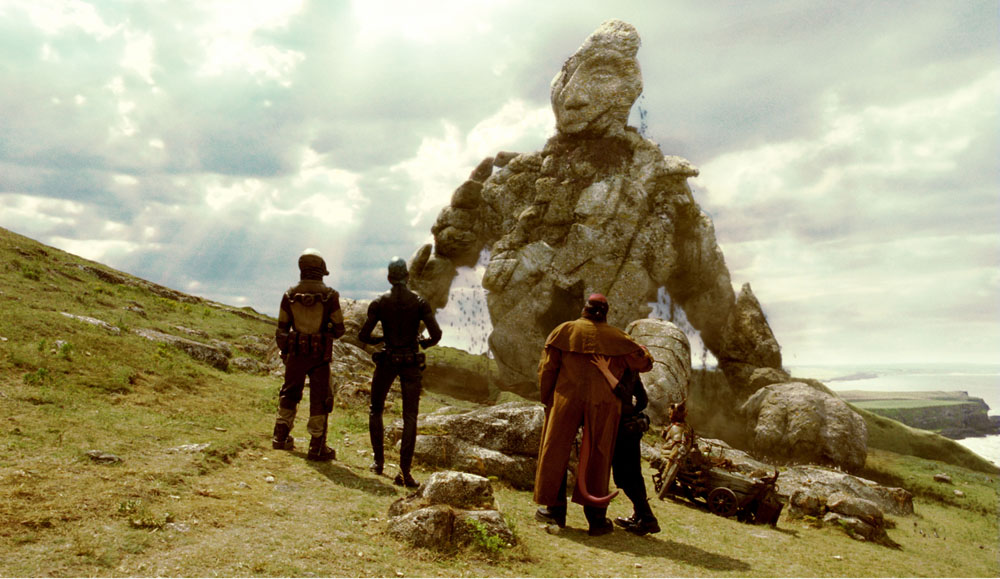
2004’s Hellboy is, in many respects, the perfect comic adaptation. It worked brilliantly thanks to writer/director Guillermo del Toro’s talent, passion and understanding of the source material. That and the fact he worked closely with the character’s creator Mike Mignola, and he found the only man who could have ever have brought said character to life, meant that the team had all the ingredients they needed for the recipe of success. Why there were issues getting a second film off the ground is a frustrating puzzle. A sequel to 2004’s Hellboy was announced a month after the film’s release, with del Toro returning to direct and Ron Perlman reprising his lead role as the title character. The critics loved it, the fans loved it and most importantly (to the studio) it made money. Del Toro wanted to create a film trilogy with the first sequel anticipated for release in 2006. Revolution Studios planned to produce the film and distribute it through a deal with Columbia Pictures, but by 2006, their distribution deal wasn't renewed and Revolution began refocusing on exploiting their film library. In August 2006, Universal Pictures acquired the project with the intent to finance and distribute the sequel, which was newly scheduled to be released in summer of 2008. Quite why Revolution Studios struggled with this is a mystery. With the passing of time, the original idea became something entirely new. del Toro explored several concepts for the sequel, initially planning to recreate the classic versions of Frankenstein, Dracula and The Wolf Man. He and Hellboy creator Mike Mignola also spent a few days adapting the Almost Colossus story, featuring Roger the Homunculus. They then found it easier to create an original story based on folklore, because del Toro was planning Pan's Labyrinth, and Mignola's comics were becoming increasingly based on mythology. Later, del Toro pitched a premise that involved four Titans from the four corners of Earth - Wind, Water, Fire, and Earth - before he replaced the Titans with a Golden Army. Mignola described the theme of the sequel, "The focus is more on the folklore and fairy tale aspect of Hellboy. It's not Nazis, machines and mad scientists but the old gods and characters who have been kind of shoved out of our world.” Del Toro released Pan's Labyrinth in 2006, and the film earned multiple Academy Awards, providing the director enough clout to begin production on the film with almost complete control. It was a frustrating wait and it felt like the film would never come but as it happened the delay was a good thing as far as the story went. I liked the new direction of story, it worked and felt true to what del Toro was getting known for and the direction a lot of Mignola's work was going. I also loved the way they got John Hurt to return. During Christmas 1955, a young Hellboy is told a bedtime story by his adoptive father, Trevor Bruttenholm (Hurt), of an ancient war between human and magical creatures. After the magical creatures are driven back by the humans, the goblin blacksmiths extend an offer to Balor, king of the elves, to build him an indestructible mechanical army. Encouraged by his son Prince Nuada, Balor accepts; the Golden Army subsequently devastates humanity. Regretting his actions, Balor forms a truce with the humans, that they will keep to the cities and the magical creatures to the forests. The crown to command the Golden Army, which can only be worn by one of royal blood, is split into three pieces. Nuada, disagreeing with the truce, leaves in exile. In the present, Nuada (Luke Goss of Bros fame) returns and begins gathering the pieces of the crown. He collects the first piece from an auction, unleashing tooth fairies, voracious flying creatures that eat the crowd alive, and kills his father for the second piece. His twin sister, Princess Nuala, escapes with the final piece. Meanwhile, at the B.P.R.D., Hellboy is having issues with his girlfriend Liz, and dislikes that their organization must operate in secrecy. Investigating the auction slaughter, Hellboy allows himself to be revealed to the world. In the commotion, Abe Sapien discovers Liz is pregnant; she swears him to secrecy. Furious at Hellboy's actions, the Bureau's superiors send the ectoplasmic medium Johann Krauss to rein him in. With Krauss in charge, the team tracks the tooth fairies to a secret market under New York’s Brooklyn Bridge. Abe finds Nuala, who has obtained a map leading to the Golden Army, and falls in love with her. Hellboy fights and kills Nuada's accomplice Wink and an elemental forest god that Nuada summons against him. During the fight Nuada questions why he fights for the humans when they have driven the magical creatures into hiding, of which he too is one. Nuala is taken under the B.P.R.D.'s protection. Nuada tracks his sister to the B.P.R.D. headquarters using their magical bond, which causes them to share wounds and read each other's thoughts. Nuala hides the final crown piece before Nuada finds her and he battles Hellboy. Nuada critically wounds Hellboy with his spear and abducts Nuala, promising her return in exchange for the crown piece. Unable to remove the spear shard in his wound, Liz and Abe decide to take Hellboy to the Golden Army's location in the Giants Causeway in Northern Ireland. Krauss comes along, as he sympathizes with Liz, revealing that he too lost his wife in the accident that caused the loss of his own body. They encounter the Bethmoora goblin master blacksmith who brings them before the Angel of Death to retrieve the spear shard. Though warned Hellboy will doom humanity if he lives and that she will suffer the most from it, Liz pleads for Hellboy's life. The Angel removes the shard from Hellboy's chest and tells Liz to give him a reason to live. She reveals to Hellboy that he will be a father, and he recovers. The goblin leads the team to the resting place of the Golden Army, where Nuada awaits them. Abe gives him the last piece of the crown, and Nuada awakens the Golden Army and commands them to kill the team. Hellboy challenges Nuada for the right to command the army; as Hellboy is a member of Hell's royal family, Nuada must accept the challenge. Hellboy defeats Nuada and spares his life, but Nuada tries stabbing him. Nuala commits suicide to stop her brother; the dying Nuada tells Hellboy he will have to choose whether humanity or magical beings must die. Abe psychically shares his feelings with Nuala before she dies. Liz melts the crown apart, deactivating the Golden Army. Hellboy, Liz, Abe, and Johann resign from the B.P.R.D., and Hellboy contemplates his future life with Liz and their baby. Liz corrects "babies", revealing that she is pregnant with twins. It is a crime against cinema that we never saw a third installment, especially featuring baby Hellboys/Hellgirls. The special effects were amazing, so much so that even the fantasy elements were believable. All the key players were back and Doug Jones was allowed to use his own voice. The sequel was far more fast and loose than the first, which suited the established humour rather well and let the characters shine over the story. While I’m not alone in feeling completely robbed of a third film, the story is left in a nice place. I will try to appreciate Hellboy II in all its greatness without wondering what could have come next, as perhaps we all should.

Hellboy
Dir: Guillermo del Toro
2004
*****
There are so many comic that deserve a live-action big screen adaptation but I just can’t see it happening for many of my personal favourites. I never in my wildest dreams would have thought Hellboy would or could have been made into a movie, certainly not a big studio PG13 one. When you talk about comic and superhero adaptations the subject usually revolves around Marvel vs DC, how Marvel got it right and where DC got it wrong. It is becoming a tired conversation to be honest, as much as I love the films. The one thing that really annoys me though is when people spend hours stating how good 2008’s Iron Man is. Yeah, it is good, it was the beginning of something much bigger that we all love but four years before that, one of the greatest comic book adaptations was released and it was a far greater achievement. There is no way you can adapt any of the Hellboy stories into film and there is even less chance you could ever find anyone to portray the character authentically, and yet Guillermo del Toro and Ron Pearlman did just that. It isn’t my favourite superhero/comic book adaptation of all time, it is certainly on the list, but I would argue that it is probably the most accomplished and authentic an adaptation than anything that has come before or after. I think starting off with an adaptation of Hellboy: Seed of Destruction was a clever move, an obvious choice perhaps but certainly not the easiest of the Hellboy stories to adapt. There are aspects of Right Hand of Doom and Box Full of Evil but the core is Seed of Destruction, with a few nods to The Corpse and Pancakes (“Pamcakes”) for the hardcore fans. For an origins story the origin part is kept fairly short. In 1944, with the help of Russian mystic Grigori Rasputin, the Nazis build a dimensional portal off the coast of Scotland and intend to free the Ogdru Jahad - monstrous entities imprisoned in deep space straight out of a H.P. Lovecraft story - to aid them in defeating the Allied forces. Rasputin opens the portal with the aid of his disciples, Ilsa von Haupstein and Obersturmbannführer Karl Ruprecht Kroenen, member of the Thule Society and Adolf Hitler's top assassin. An Allied team is sent to destroy the portal, guided by a young scientist named Trevor Bruttenholm, who is well-versed in the occult. The German team is killed and the portal is destroyed - in the process absorbing Rasputin - while Haupstein and Kroenen escape. The Allied team discovers that an infant demon with a right hand of stone has come through the portal; they dub him "Hellboy" and Bruttenholm adopts him. Sixty years later, FBI agent John Myers (Rupert Evens) is transferred to the Bureau of Paranormal Research and Defense (BPRD) at the request of Bruttenholm (John Hurt), where he meets the adult Hellboy (Pearlman) and a psychic, amphibious humanoid named Abe Sapien (played by Doug Jones and voiced by David Hyde Pierce) . He learns that a third BPRD member, Liz Sherman (Selma Blair), has recently checked into a mental hospital to protect others from her volatile pyrokinetic abilities. Despite regular visits and coaxing from Hellboy, she is determined not to return. Meanwhile, Kroenen and Haupstein resurrect Rasputin in the mountains of Moldova and the three unleash a demon known as Sammael. Rasputin imbues Sammael with the power to reincarnate and split his essence, causing two of the creature's eggs to hatch and mature each time one dies. Rasputin visits Liz as she sleeps, activating her powers and almost destroying the hospital. Myers persuades her to return to the Bureau. Sammael's ability to multiply becomes a problem as Hellboy repeatedly kills it and dozens more are born. Concluding the eggs are in the sewer, Hellboy, Abe and several FBI agents go down the sewer to destroy them. Abe is injured while looking for the eggs, while Kroenen kills most of the agents. Kroenen, whose mutilated body is run by mechanical parts, shuts himself down, pretending to be defeated. Kroenen's body is brought to the bureau. FBI Director Tom Manning (Jeffrey Tambor) is angered by Hellboy's recklessness. Myers takes Liz out for coffee and to talk. Hellboy, jealous, covertly follows them, leaving the bureau unguarded. Kroenen reanimates himself and Rasputin appears at the bureau, confronting Professor Bruttenholm. Rasputin offers him a vision of the future, showing Hellboy is the agent that will destroy the world. However, Bruttenholm tells Rasputin he will always see Hellboy as his son. Rasputin, respecting Bruttenholm for raising Hellboy, directs a quick death. Bruttenholm is stabbed in the neck by Kroenen and dies clutching a rosary. Manning takes over the BPRD and locates Rasputin's mausoleum in an old cemetery outside Moscow, Russia. A team led by Manning and Hellboy enters the mausoleum, but swiftly becomes separated. Hellboy and Manning find their way to Kroenen's lair and kill him by impaling the assassin on a metal spike, then crushing him with a gear. Hellboy reunites with Liz and Myers at Sammael's new nest, but the creatures overwhelm them. Liz uses her pyrokinetic powers to incinerate the Sammaels and their eggs. Hellboy, Liz and Myers lose consciousness and are captured by Rasputin and Haupstein. Rasputin sucks Liz's soul out of her body, then tells Hellboy to release the Ogdru Jahad in return for her soul. Hellboy awakens his true power as Anung un Rama, causing his horns to regrow, and begins to release the Ogdru Jahad. Myers breaks out of his restraints, subdues Haupstein, and reminds Hellboy that he can defy his destiny, throwing Bruttenholm's rosary to him. Remembering his true self and what Bruttenholm brought him up to be, Hellboy breaks off his horns, reseals the Ogdru Jahad and stabs Rasputin in the stomach with one of his broken horns. A very cool moment indeed. Succumbing to his wound, Rasputin allows himself to be possessed by a creature from the Ogdru Jahad. The tentacled Behemoth bursts out of his body and grows to immense size, killing him and Haupstein. Hellboy allows himself to be swallowed by the beast, then detonates a belt of hand grenades and destroys it from the inside. He whispers something in Liz's ear and she is revived. When she asks how her soul was returned, Hellboy replies that he said "Hey, you on the other side, let her go, because for.. for her I'll cross over, and then you'll be sorry'. One of the most romantic moments in a superhero/comic adaptations? I think so. Upon meeting to discuss the movie, Hellboy creator and co-executive producer Mike Mignola and writer/director Guillermo del Toro decided to reveal to each other their choice for the lead role of Hellboy. They both said at the same time, “Ron Perlman”. It was meant to be. del Toro understood Mignola’s creation and Mignola loved what del Toro did with it. This sort of thing never happens and that is why it is so perfect. del Toro kept the producers at bay too, never once compromising the character. When del Toro originally met with producers, many changes to the Hellboy character were suggested. One idea was to have Hellboy be a human who transforms into Hellboy when he gets angry. Another suggestion was that he came from Hell, but was a normal human. del Toro vetoed all such attempts to alter the character. I guess the only real change was the decision to not make the film too bloody, so as to avoid an R-rating. The graphic novels are pretty graphic it has to be said, so they came up with lots of interesting ways of substituting the blood for something else. Ron Perlman suggested that in one fight scene, Hellboy could grab a gumball machine and start beating the monster over the head with it, with the flying gumballs standing in for the blood. They used the idea in another scene, where Hellboy rips a payphone off the wall and beats the monster over the head with the phone, with the coins that go flying out standing in for the blood. It’s not the same as the comic but it still feels fairly authentic and in-line with the humour. My only criticism was that Doug Jones wasn’t allowed to do his own voice. I adore David Hyde Pierce and his voice fit Abe perfectly but he himself decided to go uncredited, as it was Jones who embodied the character and actually, Jones doesn’t sound that different to Hyde Pierce anyway. Apart from that, I consider it the perfect comic adaptation, thanks to understanding, communication and a brilliant team who were all on the same page.